Withdrawal and Return
Reflections on the Lectionary for August 2nd

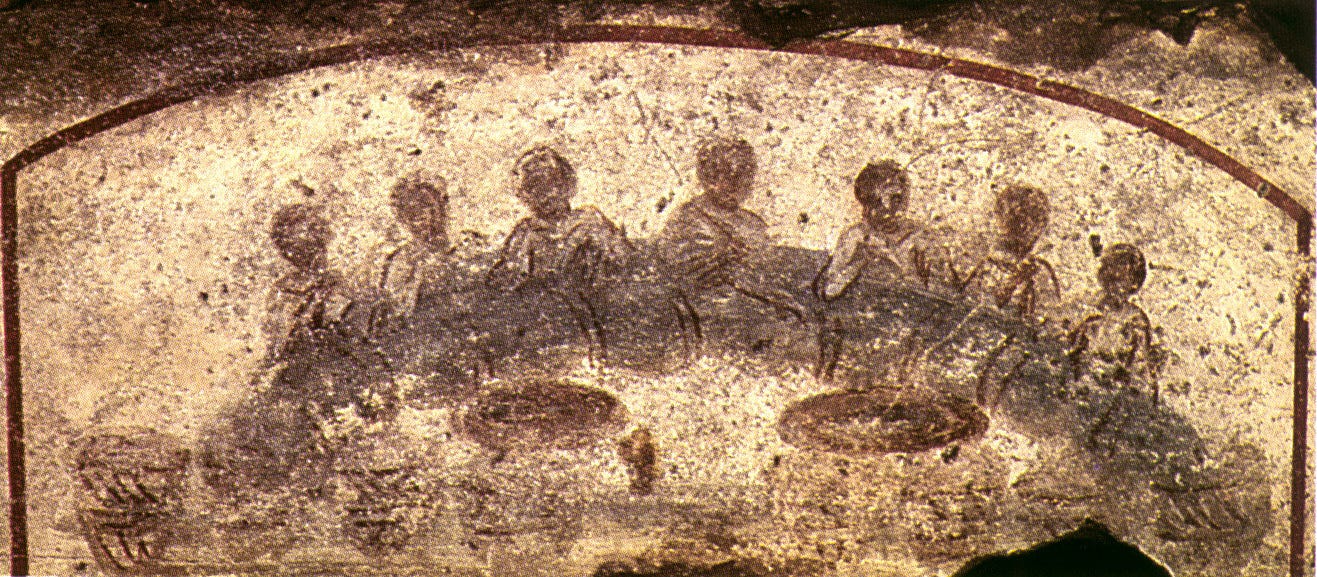
The biggest crowd Jesus is ever said to have spoken to—a group of maybe fifteen or twenty thousand people—gathered at precisely the moment he was trying to get away from everyone.
Now, we could quibble with the numbers included in the gospel reading in the lectionary reading this week. Maybe this is a case of biblical exaggeration, and Jesus spoke to only a fraction of that crowd that Matthew describes. Maybe it was five thousand total people, instead of five thousand men plus uncounted women and children, as the text says. Or maybe it was only a few hundred people altogether. Maybe it was the kind of event that looms larger in memory. Maybe the scale is amped up for effect. (It’s worth noting, though, that this is one of the few stories included in all four canonical gospels, and one of only two miracles, alongside the resurrection, that merits mention by all four evangelists. Matthew and Mark liked it so much that they told it twice: once with 5000 men, and once with 4000). It could very well be the case that the numbers in this story aren’t meant to be taken at face value, or that they grew in the telling of the story, or something like that. Fifteen or twenty thousand people is an awful lot for an unamplified gathering in a sparsely populated non-urban area.
But it’s clear that the gospel writers meant for the reader to imagine a very large crowd, and nowhere is a larger number given for any of Jesus’ other appearances. Scholars arrive at that number—fifteen to twenty thousand—by guesstimating the number of women and children who might have accompanied five thousand men. That guesstimate could be wrong, but even if it’s wrong tenfold, this was still an extremely large and unplanned gathering.
That’s the part of this story that grabs my attention—the unplanned-ness of it. In 14:13, this part of Matthew begins with Jesus withdrawing from the public, traveling by boat away from the crowds, and finding a place where he could be alone. Perhaps many of us can relate. None of us is Jesus, and not many of us draw crowds like that, but we still know what it’s like to be pressed upon, wrung out, and sought after. We know what it’s like to have too many people clamoring for our attention, or too many algorithms, or too much work, or too much worry. We might be able to imagine what drove Jesus to find a boat to slip away in. We might find our own boats sometimes.
I just got back from six weeks in a boat, metaphorically speaking. As you may know, I’m working on a MFA in creative writing, and the program happens in six-week sessions in the summers. The setting is beautiful and secluded, with strange and lovely gothic-inspired architecture and lots of moss and lichen and a deep history of books and literature. It’s an absolute privilege to be able to slip most of my obligations and go off into the forest to write and read. I know that I am living a charmed life. And yet, it feels necessary to me somehow. I spent most of the past year trying desperately to write something creative, and failing. I wrote a lot of things. I wrote a lot of sermons, and 52 editions of this Substack, and a book that you can preorder now, and so many emails, and some creative stuff that never quite lived up to my hopes and expectations. I simply had too many other obligations pulling on me, and I could never find the mental space to sink into the kind of focus and reverie that lets me write my best creative work.
As soon as I unloaded my suitcases and books from the car for my six weeks of creative writing, however, the words started flowing. The words came plentiful—about 50,000 of them across six weeks, in my rough estimate—but many of them were also good words, if I do say so myself. By finding seclusion and separation from my many professional obligations, I was able to access a part of myself that I struggle to find in my everyday life. I was able to think and write more clearly during that time than in the other 46 weeks of the year combined.
I can’t do that all the time. Not many of us can. Most of us have to juggle our many obligations all at once, and most of us have to parcel out our attention across many different demands. I’m back in Colorado now, back at work, getting ready for fall classes and new research projects and planning sermons and committee meetings and writing emails—always emails—in a constant stream of tasks. The real world always claims you back.
That’s what happened to Jesus, although I don’t think he got six weeks. He rowed his boat over to some deserted place to be alone, but the real world found him fast. The crowds heard that he had moved on, and they followed Jesus around the edge of the water and tracked him down on the other side. And it was a huge crowd, too, thousands of people if we trust the numbers, a throng of people enthusiastic about Jesus and what he had to say.
What was Jesus thinking about when all those people showed up? We get the slightest glimpse here, in 14:14, of what the creative writing folks call interiority. That’s when a writer gives a glimpse into the mind of a character, and lets the reader in on the person’s state of mind. There’s nothing that says that a writer has to do this; it’s possible to write a scene in a strict third-person perspective where the narrator simply describes what is happening. But sometimes writers let the reader inside, into the mind of the characters, and that’s called interiority. Sometimes interiority plays out in elaborate stream-of-consciousness paragraphs, and sometimes an author will show interiority as expressions of sureness or uncertainty or hesitation or steadfastness. As readers, we might get a glimpse of the conflict going on in the mind of a character, or the things distracting them, or what they’re hoping for.
The interiority in 14:14 is simple: he had compassion for them.
This isn’t a lot to hold on, as far as interiority goes. Some would say that it might not even be interiority at all, in the strictest sense, since it might be chalked up to an observation made about Jesus’ actions by the narrator. But I think of it as interiority because this little clause tells us why Jesus did what he did—not because he felt obligation of some kind, and not because he necessarily wanted or enjoyed the attention, but because he had compassion for the people. We see a bit of Jesus’ motivation here; we get a slight sense of what makes him tick.
I suspect that something similar guides our own actions. The push-and-pull between retreat and return, between aloneness and sociality, is probably governed in no small part by our sense of compassion. Other people need us, whether it’s a need grounded in family or work or charity or romance, and that’s what pulls us back to other human beings. We know that other people rely on us, and that we can’t stay separate forever. And so we return.
Jesus’ return to the crowds leads to one of the iconic stories of the gospels, which is usually called the multiplication of loaves and fishes or the feeding of the multitude. There are a couple of ways to understand the miracle here—a couple of major interpretations. Some view this as a straightforward miracle, with Jesus just making new food out of the old and multiplying it. The other view—the one I have heard more frequently in progressive circles—is that this is a story about sharing, and that it shows us how there is enough to go around when we all share what we have. Both interpretations are fine, as far as I’m concerned. Whether it was Jesus conjuring fish or people realizing they could feed their neighbor with their extra bread, it’s a nice story.
I’m stuck, though, on the structure of this story—on the way the miraculous part is married to the part about Jesus wanting seclusion. There was nothing demanding that the story be told this way. This passage could begin in 14:15 without any damage to its miraculous nature; the main plot doesn’t need the bit about Jesus withdrawing to a deserted place by himself. That part is superfluous to the scene with the bread and fish. The bread and fish part works just fine without the reader knowing that Jesus had tried to get away, and had been pulled back into the crowds by their doggedness and by his own sense of compassion.
Why are these two scenes linked like this, then? Why do we need to know that Jesus was trying to get away before we can see him perform this miracle?
I can imagine a lot of different answers to those questions. Maybe it’s to show Jesus’ humanity—that he got tired too. Maybe it’s a demonstration of power—that Jesus could do big and impressive things even when he didn’t feel like it. Maybe it’s because it actually happened that way, and the gospel writers are just being historically accurate.
But I think my preferred explanation—my rationale for why this story is told in this way—is that it’s just the way things are. There might not be some hidden spiritual meaning in Jesus withdrawal and return. That might just be the way life is—that our attempts to find replenishment and restoration are rest are often thwarted, and that they are thwarted by good and worthwhile things. Jesus’ withdrawal wasn’t interrupted by someone’s nefarious meddling or thoughtless needs; Jesus’ withdrawal was interrupted by his life’s work and the thing that he was most compelled to feel compassion about. For all the talk we hear of self-care, that’s how it usually shakes out: we always make time for the things that trigger compassion in us, and the things that we think are most important, even if that time comes out of our own rest and restoration.
As much as we like our withdrawal and our rest—as much as we value our time apart—many of us, like Jesus, also value the crowd. We like being a part of something; we enjoy the gifts of community. One of the earliest motifs of Christian art was baskets of bread (as in the image above), and scholars have kicked around the idea that those baskets might be linked somehow to these stories of feeding the multitudes. (There’s not much consensus on the matter). That’s what the tradition founded in Jesus’ name ended up valuing as much as anything—the sharing of bread, the common table, the blessings of being together. I think Jesus would approve. I think he would have thought it worth the interruption to his time apart, to see the multitude fed.