The Bible's Hidden Resistance
Reflections on NOT the Lectionary, for Once

Many times during the past fifteen years or so, I have felt overwhelmed and despondent because of things happening in the world around me. When Trayvon Martin and Michael Brown were killed without reason and with few consequences, it felt like something was coming undone in the world. When others continued to die in the same way and it became clear that things were not going to change quickly, I felt a heavy grief about the future. When the “birther” movement gained momentum and open racism found new footholds in American life, I felt foolish to have ever been optimistic about the Obama era. The open misogyny of the 2016 election, the chaos and isolation of the pandemic, the erosion of public trust in science and the return of MAGA-style paranoid politics, January 6th, the violence and destruction in Gaza and in many other places, the ongoing spiral of climate change—it has all weighed heavily on me.
But I don’t think I have ever felt like I have felt this past week. I can’t recall fear and despair like this before. I keep trying to remind myself to put things in perspective and remember that there have been moments of real crisis and hopelessness at other times recently, but this feels different. The first full week of January 2026 felt like the week that the last guardrails broke and some kind of collision became inevitable. We kidnapped another country’s president and quickly made that country a petro-state puppet regime. (Not many are longing for a return to Maduro, but the precedent is alarming to say the least). Trump said that the United States’ actions in Venezuela would be constrained only by the president’s “own morality,” which is not reassuring. We are openly threatening war against our closest allies in a bid to seize Greenland. Bands of paramilitary forces roam American cities, rounding up anyone who seems to not belong by whatever arbitrary racist standard someone wants to apply, without regard to due process or status. Just this week already those secret police have shot several people, killing at least one, and several states are facing the prospect of deploying state forces to oppose national ones. The official position of the United States is that the January 6th insurrection was fine, actually, and that the rioters who beat and tazed cops that day are heroes who deserve honor and restitution. The Corporation for Public Broadcasting officially passed into memory, the food pyramid was inverted to give beef tallow and alcohol new positions of honor, many childhood vaccines were taken off the list to be given regularly, vapid AI slop is everywhere, and Russia just fired a nuclear-capable missile into Ukraine. Things are bad.
With all that in mind, I looked at the lectionary readings for January 18th, hopeful for some wisdom or inspiration. That often happens—that the lectionary will hold some spookily-appropriate reading that somehow speaks into the present moment with prescience and insight. But this time I didn’t find much to hang onto. That’s ok—the lectionary cannot be expected to speak into every eventuality and ephemeral condition of the world. That’s why many people abide by that old saying, that we should “preach with the Bible in one hand and the newspaper in the other,” drawing inspiration from current events as much as sacred texts. There’s nothing magical about the Revised Common Lectionary or any other lectionary. It just happens to be very influential in the traditions of Christianity I know best, so I find it useful to think alongside it. I know, though, that many readers of this Substack don’t use a lectionary at all, and that they rely on the Spirit to lead them to useful and interesting biblical texts for use each week.
In that spirit (or maybe in that Spirit), I thought it might be useful to collect a few passages that have floated to the top of my mind recently, and offer them up as possible sites of reflection for the living of our current days. Some of these passages are found in the lectionary in one way or another, so it’s not as if they are neglected in the tradition. And some of them are missing from the lectionary, and therefore don’t get much attention in churches that follow it. But if you are looking, like I am, for some ways to grasp the circumstances we are living in, then maybe something on this list will be helpful to you.
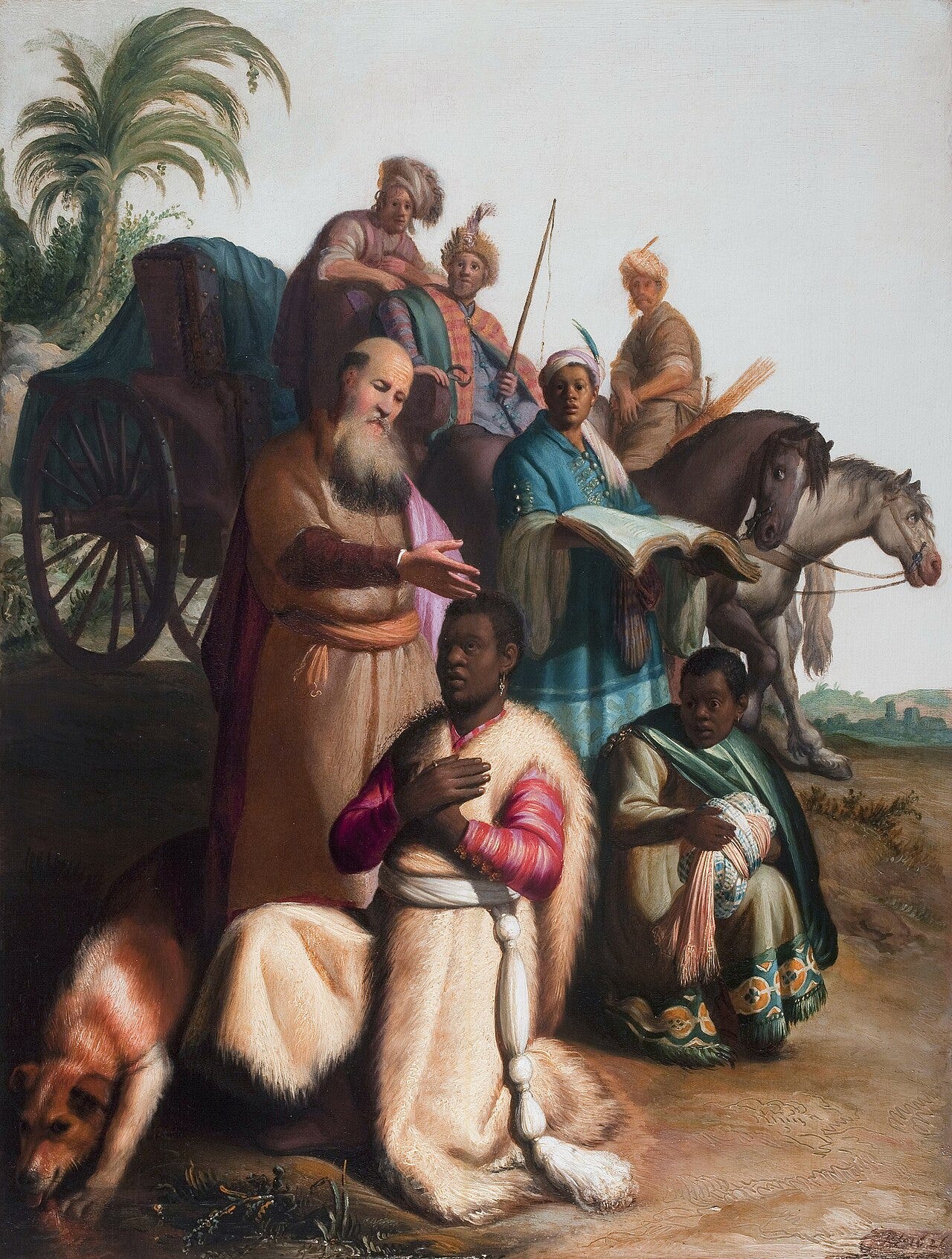
Acts 8:26-40 is one of my favorite stories in the Bible, and it’s one that I have been writing about regularly for the past six years now, as part of a couple of books that I have coming out later this year. I love this story—as others do—for its swirl of complicated identifications and allegiances. Its narrative structure is straightforward: the apostle Phillip is sent to a wilderness road where he meets a traveler. They have a conversation, and the traveler professes belief and seeks baptism. After baptizing the traveler, Phillip is swept off to another place. It’s when you look closely at the details, though, that this story becomes provocative and even radical, especially for an age like ours. First of all, the traveler was Ethiopian, which means that he was not Roman—he was a foreigner and an outsider. He would have had dark skin and his presence would have been symbolic of life beyond the borders of the Roman Empire. Furthermore, the Ethiopian was a eunuch. Most likely, that meant that he was enslaved, and that he had been castrated as a youth to make him more suitable for imperial service. So the Ethiopian eunuch was a gender and sexual minority and subject to the power and violence of systematic slavery. And yet, the Ethiopian traveler was also described with lots of markers of privilege: he was riding in a carriage, he carried a scroll of the prophet Isaiah, and he was a court official of the Candace, which was the title of the queens of Ethiopia, and he had the position of treasurer. In this story of the Ethiopian eunuch, then, we have a remarkable affirmation of difference and inclusion—a story about inclusion and belonging that transcends boundaries of politics, geography, peoplehood, gender, sexuality, and class and status. Acts went out of its way to tell this story this way, which is a comforting reminder of the Bible’s inclusive vision, at a time when the broader American government and culture has begun to idolize exclusion and hatred.
Isaiah 28 is a powerful chapter, but really I am including it here simply as a placeholder for many other prophetic texts. The prophets are full of millennia-old passages that would get you denounced as woke by people on Twitter in 2026. Isaiah 28 is a diatribe against corrupt rulers. It is an indictment of political and religious leaders who are described as prideful and drunken and confused. Those corrupt leaders say, “we have made a covenant with death, and with Sheol we have an agreement; when the overwhelming scourge passes through, it will not come to us. For we have made lies our refuge, and in falsehood we have taken shelter.” There’s a little political theology hidden in there, in photographic negative: that a good ruler will covenant with life and not death, that a good ruler will deal in truth and not lies, that a good ruler will not seek security at the expense of the people and will not hide away to keep themselves safe while everyone else suffers. The corrupt rulers of Isaiah 28 fail the test on all accounts, and it doesn’t take much work to find examples of rulers in our own place and time who similarly fail to measure up.
The Book of Revelation is mostly omitted from the Revised Common Lectionary, which is a pity. While Revelation can be difficult to understand and frightening, and while recently it has been mostly owned by evangelical forms of Christianity in the United States, Revelation is also Christianity’s most sustained argument against empire, greed, and depravity. Revelation critiques Rome, but more than that it critiques the way all imperial systems deal in death and suffering. Chapters 17 and 18 are complicated and grotesque and deeply misogynistic, but they are worth reading and engaging because they draw connections between political ideology, power, money, and religious life. Chapter 18 in particular is a withering denouncement of what we might call imperial capitalism, familiar from our own day and time, and its practices of selling out human beings for profit and power.
I recently saw an exchange on the internet where someone asked a supporter of President Trump which teachings of Jesus, exactly, he thought the President was following and advancing. Trump’s supporter replied with the “give a man a fish and he will eat for a day, but teach a man to fish and he will eat for a lifetime” saying, which while wise was not said by Jesus but Confucius. The upshot of the exchange, at least as the folks on the internet were interpreting it, was that Trump’s supporters think he’s advancing the teachings of Jesus, but that they don’t actually know much about what Jesus taught, and Trump isn’t paying very much attention to Christian ideas. As I read that exchange, I thought about Luke 4:16-30. This passage does show up in the lectionary, because it’s an iconic moment in the life of Jesus. But it’s worth revisiting, because it’s such a powerful and compact summarization of everything Jesus taught. Like the Isaiah passage that Jesus is reading in this story, Jesus preached and practiced things that look both timely and radical in our world: release to the captives, healing to the sick, good news to the poor, and freedom for the oppressed. There is nothing in Luke 4:16-30 that fits with President Trump’s agenda and actions, and if anything this passage underscores how profoundly un-Christian the actions of the United States government have become. Not that the actions of the government need to be Christian; we are a secular democracy, not a theocracy. But it’s remarkable how much cognitive dissonance is required to be both a Christian and a supporter of this regime.
Romans 16 is overlooked in so many ways. It is not a poetic passage. It contains no great or famous teachings. You’ve probably never heard a sermon or read a devotional about it. But it’s one of my favorite chapters in the New Testament, because it offers us a glimpse behind the scenes of the early Jesus movement. In this chapter, which comes at the end of Romans, Paul is sending greetings to everyone he knows in Rome. That was a practice with a couple of purposes. First, it was just practical. In an age before telecommunications, if you were already sending a letter somewhere, it just made sense to piggyback on that letter and say hello to your friends while you were at it. But second, the practice of including greetings served another purpose: to help build and maintain trust with friends and strangers. By greeting so many people in Romans 16, Paul was demonstrating to the Romans he didn’t know that he had a lot of friends, and that he could be trusted. We do this all the time—we meet someone and discover mutual friends who can help us build connections. What’s remarkable about Romans 16 is who he greets. Scholars have pointed out that—based on names—many of the people in this chapter would have been enslaved. And women show up frequently here in this chapter: Phoebe, Prisca, Mary, Junia (who is called an apostle), Tryphaena, Tryphosa, Persis, the mother of Rufus, Julia, and the sister of Nereus. As scholars have pointed out, not only is Paul greeting these women, but he is also describing them as hard-working and daring, pointing to their role in the Jesus movement. While Paul has a reputation for misogyny (partly deserved, partly not deserved, as I have argued elsewhere), here we see him using the valuable real estate at the end of a letter to lift up the contributions of women.
Matthew 1:1-17 is not thrilling prose. It doesn’t have a plot, at least not anywhere near the surface, and it’s quite repetitive. For that reason, it doesn’t show up in the lectionary. This is Matthew’s version of Jesus’ genealogy (which differs substantially from Luke’s version), and it draws a connection back from Jesus to Abraham, the great patriarch of the people of Israel. What I love about this genealogy is that Matthew constructs it in the most subversive way possible. The big picture of this genealogy is that Matthew wants us to understand Jesus as a natural endpoint of Israelite history—that history was always pointing to Jesus. He writes the genealogy so that there were fourteen generations from Abraham to David, fourteen from David to the deportation to Babylon, and fourteen from the exile to Jesus. By arranging history this way, Matthew is leaving out some obvious figures; it’s not meant to be a literal genealogy, but a claim to inheritance and purpose. But he’s also including some important cues to the reader that tell them how to think about Jesus and the history that produced him. Most remarkably, he includes five women in this lineage. Obviously everyone’s lineage includes women, but it was not ordinary in those days to pay much attention to them. Matthew, though, makes a point of naming five of them: Tamar, Rahab, Ruth, the wife of Uriah (who we know as Bathsheba), and Mary. The inclusion of women should alert us that Matthew was going out of his way to show us something, and when we look closely at the stories of those women we can start to get a sense of what it was. Amy-Jill Levine has said that all five of these women had “obstetrical irregularities,” which is a way of saying that they all gave birth in unusual ways. Tamar and Ruth procreated after insisting on their rights under Levirite marriage rules, and both of them employed deception to accomplish it. Rahab was a sex worker who helped the Israelites as a spy. Bathsheba was either the victim of exploitation or the willing participant in an affair, depending on how you read the story. And Mary, of course, turned up pregnant before marriage, and was said by some to have given birth as a virgin. Furthermore, as Levine has pointed out, all of these women except Mary were gentiles—non-Jews who contributed to the story of Israel and to the bloodline of the Messiah. I like this passage as an example of how Matthew sneaks a radical message into a mundane text. Matthew is using something as boring as a genealogy to show that it wasn’t only heroes like Abraham and David who made Jesus’ life possible, but also outsiders and people on the low end of the social ladder. It’s a reminder—useful to us today, I think—that the people who seem to be in charge are not always the most important people in the long run, and small acts of resistance can pay off in big ways.
I could go on, and maybe sometime I’ll do another installment of these. For now, though, I hope you’ll find something in these passages that inspires you. We are living in frightening and dangerous times, but we are far from the first people to do so, and we can take comfort in the stories of the people who have gone before us, speaking truth to power, working for justice, and quietly but persistently throwing the powerful down from their thrones.
Thank you for this list. I am not usually a lectionary preacher, even less these days. The selections you offered are thought-provoking and useful for preaching or daily reflection.