Surviving the Apocalypse
Reflections on the Lectionary for September 28th

If you prefer to listen to this post as a podcast, click here!
Ignore all the strange names and disregard all the unfamiliar places. Don’t try to keep track of the real estate law of the seventh century BCE. You can even skip past the gnarly geopolitics that sit behind this story. Instead, focus on the audacity. Pay attention to the foolishness.
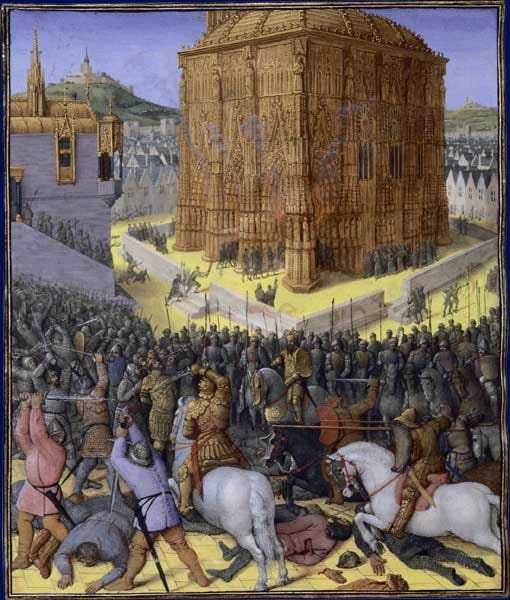
To make a long story short, Jeremiah bought a field, and he bought it right at the moment that it seemed likely that the field he was buying—and indeed all fields everywhere around—would soon become worthless. An army was camped out nearby, and it was the army of a great and powerful empire. The army had encircled the city and laid siege to it, and really it was all over but the shouting. The Babylonians were about to conquer everything, and titles to land were about to become worthless, and Jeremiah went out and plunked down good money for land that soon would not be worth the papyrus its deed was written on.
Apocalyptic times make people do strange things. I like movies and television shows about apocalypses, because I find strange pleasure in imagining what happens when everything breaks down. Sometimes in those movies and shows, people lose their sanity. Sometimes they invest fully into the things and the people they love. In those shows and movies, some of the characters become nihilistic and give themselves over to drunkenness and all kinds of debauchery. Other characters become super religious, or they go on a search for love, or they spend all their time and energy building a fortress in which to entomb themselves, where they hope to stay safe from whatever danger may come. Apocalypses are a fascinating window into human nature. They are a measure of pessimism and a barometer for hope.
The world feels a little apocalyptic to me right now, if I’m being honest. Maybe you feel that way too. I don’t have to imagine, anymore, what it looks like when things start breaking down, and I don’t have to consult any movies to jolt my imagination. I can just look around. Everything is upside down, from public health to public safety to constitutional order to the media world to the weather to the climate. Coastlines are shifting, forests are burning, cities are flooding, and the government is arresting and imprisoning and deporting people based on little more than prejudice. Horrific wars rage unabated and atrocities go unanswered. Some people feel like fascism has seized the country, and others feel like things are finally being set right, and it’s hard to imagine how those two groups of people will ever learn to talk to each other again. Things are bad.
And those are just the generic, societal, climatic, geopolitical apocalypses. On top of that, those of us in the Mainline Protestant world are living through another kind of apocalypse—a different species of disaster. A lot has been said about this, including a lot by me, so I won’t repeat all of it again. And anyway, if you’re reading this, you probably know what I’m talking about. As the world around us frays at the edges, for many of us the fabric of our religious lives is coming fully undone.
How do we live in apocalyptic times?
If Jeremiah had employed a good financial advisor or real estate agent, they would have advised him to save his money, or maybe invest it in a different field, somewhere far away from any Babylonian army. Any prudent and competent professional would have advised against buying a field, right at the moment when an invading army stood poised to seize it. Investments abhor uncertainty, and nothing manufactures uncertainty quite like an apocalypse. It doesn’t make sense to invest in the future when the future itself is in doubt. It isn’t rational to stake a claim to the future when you aren’t certain that you can survive to see it, or that a future will even be there at all.
But Jeremiah bought a field. Jeremiah made an audacious and foolish investment in the future. I signed the deed, Jeremiah wrote, I sealed it, got witnesses, and weighed the silver on scales. He did all of that in public where he was sure everyone would see it. Jeremiah wanted people to know what he had done. He wanted them to witness the confidence he had that they all would outlive the apocalypse. He wanted them to know that they would all live to see the other side.
The story of Jeremiah’s field was more than a real estate transaction. Jeremiah wanted to do more than acquire some land. The story of Jeremiah’s field was a performance of optimism. It was a demonstration of hope, meant to be witnessed by everyone around him. Jeremiah was making sure everyone knew that he believed life was waiting on the other side of destruction.
As we live through our own apocalyptic times, I find it easy to feel the way people must have felt in Jerusalem in Jeremiah’s day. There are no armies surrounding my city, but a lot of things do feel like they are falling apart. It’s easy to feel nihilistic or fatalistic or panicked about the prospects for a lot of things—for a natural world beset by climate change, for a political system besieged by people who want to undermine it and destroy it, and for various ways of life—including religious ones—that are passing into memory. Faced with those kinds of circumstances, some people flee, others dig bunkers, and some just give up. And some—like Jeremiah—become radically and foolishly hopeful.
It's easy to praise Jeremiah now. Today it doesn’t take much courage to applaud Jeremiah’s chutzpah in buying the field. After all, the story is right there in the Bible, and things seem to have turned out ok. But think about what people must have thought when it happened. I think that if I were standing there when Jeremiah plunked down his hard-earned silver in exchange for a field, with the Babylonian army stationed right outside the gates, then I would have thought that he was profoundly stupid. I would have turned to the person next to me and made some comment about what a bad investment it was. Does he not see the tens of thousands of Babylonians, armed to the teeth, ready to take his field and turn it into ash? Does he really think he can live through the onslaught that is about to come?
Everywhere I look in my professional life right now, institutions are trying to figure out how to shrink, and fast. Universities are laying off staff and faculty, expecting that their enrollments will plummet. At the same time, those same universities are rolling back their diversity programs and curtailing the academic freedom of students and faculty, afraid of being the next Columbia or Harvard and drawing the predatory attention of the Trump administration. Universities are tripping over themselves to preemptively comply with the demands of people who misunderstand and deliberately misconstrue universities’ mission, and those universities are shrinking the scope of that mission in the process. The question for many university administrators right now seems to be: can we give the bully half our lunch money so that they don’t come for the rest? Of course, that’s not how bullies work. The story in Jeremiah isn’t about offering the Babylonians half the field in the hopes that they will go away, it’s a story about claiming the field that belongs to you and having the confidence that you can outlast the invasion.
In churches, the apocalypse is about rapidly declining participation and evaporating finances, and everyone is greeting the apocalypse differently. Some are putting their heads in the sand and pretending like everything is fine. Others are panicking, offloading properties and staff in the hopes of making it through. Some are trying to manage the decline, right-sizing their way to prosperity, or at least sustainability. Nobody seems to be very confident in their approach—probably because none of the approaches seem to have much chance of success. But I am not hearing many stories that sound much like Jeremiah’s story. I am not seeing much from the church world that looks like buying a field during an invasion. What would it look like to invest in the future in a time like this?
I find that to be an interesting question. If we were to take Jeremiah seriously, and if we were to take seriously the practices of radical and foolish hope—then what would we do? What would it look like for a university to make a bet that it will outlast a presidential administration, and act accordingly? What would it look like for a church to trust that God is not finished with it yet, and invest as if it were true? What would it look like to put trust in politics at a time when it is being broken into pieces, or to have faith in the idea of your country at the moment it is being hacked into rubble? What would it look like to care for the earth in the midst of an ecological crisis, and to trust in the resilience of a million different interconnected ecosystems? What would it look like to try to know your neighbors when you have been told that technology has permanently ruptured community, or to write poetry at the very moment AI has become capable of writing it better, or to believe in humanity in a time of wars and genocides, or to plant a tree while a forest burns?
I’m asking because I do not know. I find it difficult to be hopeful very often, about very many things. I tend to pay more attention to the armies camped outside the gates. On climate, on intellectual freedom, on church vitality, on creeping technofascism—on all of the little apocalypses of our day, I am more pessimistic than optimistic, and sometimes my mood borders on nihilistic.
And maybe that’s why I need to watch Jeremiah buy a field. Maybe that’s why I need to be reminded, as Jeremiah puts it, that houses and fields and vineyards shall again be bought in this land. So many things feel like the end of the world, but in the end, almost none of them will be. The world will have one end, at most, and so the rest of these things that feel so final and severe will turn out not to last forever. The armies at the gate will get bored and move on, or they will storm the city and take it over, or they will run out of food or iron or willpower. One way or another, the crises that feel so immediate right now will pass, I have to remind myself. The people who seem so powerful now will later be weaker, and the systems that seem so broken right now might be put right again. No one lives forever, not even the bad guys, and not all change is an apocalypse. At least that’s what I try to tell myself. I wonder if that’s what Jeremiah was telling himself.
Maybe Jeremiah needed to remind himself too; maybe Jeremiah needed a way to remind himself to trust in the world’s capacity to remake itself. So he went out and he bought himself a field, to tether himself to a future he couldn’t quite see. Maybe that’s the trick to surviving an apocalypse: you have to find a way to invest in something on the other side.