Solving for Difference
Reflections on the Lectionary for Transfiguration Sunday

When I teach the New Testament intro course at the Iliff School of Theology—which I typically do between one and three times every year—I always especially enjoy the part of the class that’s devoted to the Synoptic Gospels. The Synoptics (Matthew, Mark, Luke) are fun to teach, because they are a little bit of a mystery. The mystery boils down to two big questions. First, why are the Synoptic Gospels so similar to each other? And the second is, why are the Synoptic Gospels so different from each other?
Those two questions are like two variables in an equation: the more you solve for one of the variables, the more the other variable becomes unknowable. (At least I think that might be true about variables in equations; I haven’t taken a math class in nearly 30 years). The closer you come to a satisfactory answer about why the Synoptics are so similar to each other, the harder it is to account for their differences. And the more you can zero in on an explanation for the differences, the harder it is to explain why the Synoptics should be similar to each other at all. The strange mixture of common traditions with distinctive features makes teaching—and learning—about the Synoptic Gospels a true pleasure.
One of the things I always tell students about the Gospel of Matthew is that Matthew, more than either of the other Synoptic Gospels and certainly more than John—frames Jesus’ life in terms of Moses. If you are trying to explain the differences between Matthew and the other Gospels, you could get a lot of the way there by simply noticing how Matthew always wants to make Jesus into a new Moses. The flight to Egypt in Jesus’ early childhood? Only Matthew tells that story, and he probably does it so that Jesus, like Moses, can flee from a despotic and murderous ruler and so that Jesus, like Moses, can have Egypt as a key location in his youth. The Sermon on the Mount? It’s on a “level place” in Luke, but Matthew probably puts Jesus on a mountain to make a more satisfying parallel with Moses’ reception of the law on the mountain. At several important junctures, where Matthew deviates from the Synoptic tradition, it’s likely because Matthew wants us to understand how very much like Moses Jesus was. The reasons for that are both a little bit obvious and a little bit hidden. Scholars tend to point out that Matthew was the “most Jewish” of the evangelists, but that claim leads to other important questions about what we mean by “most Jewish,” given that all the authors of the New Testament were likely Jews, and it doesn’t quite settle the question of what Matthew wants us to take away from the parallels between Jesus and Moses.
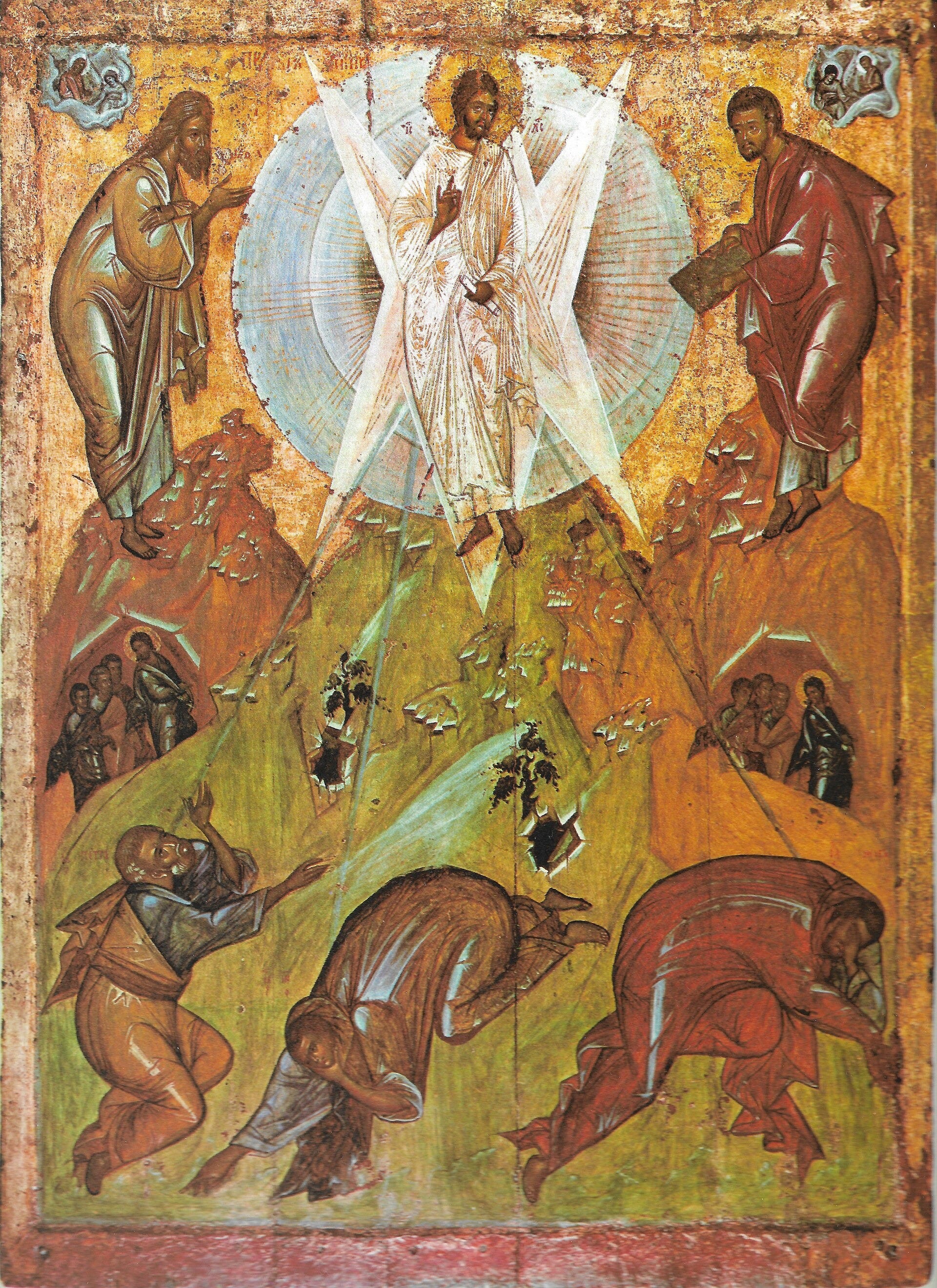
The story of the Transfiguration is a wonderful fit for Matthew’s agenda—so much that I wonder whether the specific events of the Transfiguration story were the inspiration for Matthew to frame his whole narrative in terms of parallels with the life of Moses—whether Matthew understood the Moses-centric experiences of the Transfiguration as a framework for the whole of Jesus’ life and ministry. If we just take the Transfiguration narrative as an average of all three Synoptic Gospels’ stories—without considering what’s specific to Matthew—we find a very Moses-coded story. Like Moses, Jesus goes up on a mountain. Like Moses, Jesus took three people with him (see Exodus 24:1). Like Moses, Jesus had an experience of God on the mountaintop. Like with Moses, Jesus’ appearance changed. Like with Moses, Jesus experienced God’s presence in clouds. Both stories even include Moses’ actual presence; Moses was obviously there for Moses’ mountaintop experience, but he (and Elijah) also appear in the story of Jesus’ mountaintop experience. The Transfiguration is already saturated with parallels to Moses’ experiences in Exodus, and I wonder how much the Jesus-as-Moses idea that Matthew holds so tightly might have had its origins with this story.
Before we get to the specific ways that Matthew tells this story, and the ways that Jesus’ story differs from Moses’ story, I have a question. What could it mean to tell Jesus’ story like this? What’s at stake in having Jesus undergo such a symbolic experience, and bringing him into such close conversation with Moses—a hero of Israelite history? What do the evangelists gain by sending Jesus up the mountain of the Transfiguration?
The most obvious answer is that it vaults Jesus into the upper echelon of important Israelite figures. Moses and Elijah are arguably two of the three most important people in the history of Israel, alongside Abraham, and having Jesus commune with them—as the story does—puts him in pretty rarified air. It also signals something subtle, I think, about Jesus’ role as a mouthpiece for God. Moses went up the mountain to receive the Law, after all; Moses became a conduit for God’s words. By telling this story, the Gospel-writers symbolically place Jesus in the same kind of role, as a mouthpiece for God and a conduit for God’s words—or Word, as the Gospel of John and later Christian theology would have it. Telling this story makes a lot of things clear about who Jesus is and why he matters.
But the story also clouds things a bit—no pun intended. If Moses had to ascend the mountain to meet God, does Jesus ascending the mountain imply that he had no other means to encounter God, and needed to do it on a mountain just like Moses? And if so, does that puncture the notion of Jesus’ divinity? Or, to ask a similar question, if Moses was transformed by his encounter with God atop the mountain, and his appearance was changed as a result, does Jesus’ transfigured appearance likewise suggest a transformation in him—and does that then imply that Jesus became something, on the mountain of the Transfiguration, that he had not been before? Those questions have profound implications for Christian theology, and they might not have been the kinds of questions that someone like Matthew—writing before the crystallization of Trinitarian thought—had in mind. But they are worthwhile questions for modern Christian to work through.
When we put the three versions of the Transfiguration story in parallel with each other, there are a few things worth pointing out about the distinctive ways the different Gospels tell the story. Mark’s version, for example, has Peter suggest the creation of three booths, one for you and one for Moses and one for Elijah, as a consequence of the disciples’ fear. For he (Peter) did not know what to say, for they were exceedingly afraid, 17:6 tells us. In Mark, which tends to make the disciples into bumbling and disappointing figures at every opportunity, Peter’s suggestion of preserving the moment is a mistake, prompted by his fear—the kind of thing he might not have said if he hadn’t been so afraid. Luke does something similar, having Peter make the suggestion of creating three booths while not knowing what he said, also leading the reader to believe that Peter’s construction plans were misguided, even if fear wasn’t the determining factor. But Matthew has Peter make the suggestion of the three booths in a clear state of mind, free of fear, without any suggestion that he was wrong to say it. That’s an interesting difference, I think, because it means that Matthew’s version is the one that asks the reader to accept at face value the idea that Jesus was just as important as Moses and Elijah. By omitting the idea that Peter was motivated by fear, Matthew turns Peter’s suggestion into an endorsement of Jesus’ importance.
Luke adds a detail that neither Mark nor Matthew include, which is that the disciples might have been asleep for crucial parts of the story. I say might have been, because the Greek grammar is a little unclear here, and different translations treat it differently. At Luke 9:32, the RSV says that Peter and those who were with him were heavy with sleep, and when they wakened they saw his glory and the two men who stood with him. In the RSV, the disciples fell asleep and woke to a surprising scene of Jesus and Moses and Elijah hanging out. But the NRSV reads now Peter and his companions were weighed down with sleep; but since they had stayed awake, they saw his glory and the two men who stood with him. That translation makes the disciples sleepy, but lets them stay awake for the whole event anyway. And the NRSVue reads now Peter and his companions were weighed down with sleep, but as they awoke they saw his glory and the two men who stood with him, returning to the RSV’s interpretation. It’s a small thing perhaps, but it’s a good example of how translation choices can shift the meaning of a story. Only Luke includes that vignette, though all the Synoptic Gospels say that the disciples fell asleep in the Garden of Gethsemane, near the end of Jesus’ life. Perhaps Luke was trying to build a motif out of exhausted disciples.
I want to point out one more difference between the three Synoptic accounts of the Transfiguration, this time a detail that’s (possibly) unique to Matthew, because I think it speaks to Matthew’s emphasis on Jesus as a new Moses. At the moment when Jesus begins to become transfigured, Mark says (in the NRSVue) that he was transfigured before them, and his clothes became dazzling bright, such as no one on earth could brighten them. (The Greek here actually says no fuller on earth could brighten them, and I wish the translators had put it that way rather than saying no one, because the detail of a fuller—a professional launderer, essentially, in the ancient world—adds such delightful specificity). Luke is a bit more specific, saying that the appearance of his face changed, and his clothes became as bright as a flash of lightning. Where Mark focused only on the appearance of Jesus’ clothes but possibly left room for some change in the appearance of his face with the vague he was transfigured, Luke is clear that both Jesus’ clothes and his face changed in appearance. But Luke doesn’t say how the face changed, only that it did.
Matthew, though, is most specific of the three. And he was transfigured before them, it says, and his face shone like the sun, and his clothes became bright as light. The detail of Jesus’ face shining like the sun is unique to Matthew, and while the other two accounts are vague enough that you could imagine Jesus’ face shining if you wanted to, only Matthew insists on it. That’s likely because in Exodus 34:29-35, after Moses returned from encountering God on Mount Sinai, the Israelites would see the face of Moses, that the skin of his face was shining, and Moses would put the veil on his face to shield everyone from the light. Because Moses’ face clearly shone after his encounter with God, Jesus’ face did too, because for Matthew, Jesus’ life needed to parallel the life of Moses.
For Matthew, it was important to have Jesus’ face shine—just like it was important for the Transfiguration story to include all the other parallels to the story of Moses meeting God on the mountain—because Matthew wanted the readers of his Gospel to understand that Jesus was a new Moses. Matthew wanted Jesus’ life, both here and elsewhere in the Gospel, to look like the life of Moses. Why? Matthew clearly wanted people to understand Jesus as an important figure in Israelite history, who like Moses would lead the nation out of a time of trouble and subjugation and into renewal and freedom. Matthew, more than any other Gospel, insists on telling the story of Jesus with and alongside the stories of ancient Israel, always stopping to contextualize Jesus’ actions with citations of prophetic oracles, and always ensuring that Jesus looks and acts like Moses. For Matthew, Jesus was not just any preacher, prophet, or healer. Jesus, for Matthew, was a long-foretold renewal of the same saving action of God that Israel had been experiencing for centuries already. Jesus, for Matthew, was a new expression of an old idea—that God was watching out for God’s people. On the mountain of the Transfiguration, Matthew wanted to be sure to make that point clear, so he told the story as closely to the story of Moses’ Sinai experience as he could. That makes Matthew’s version of the Transfiguration stand out a little bit, when compared to the versions from Mark and Luke. It’s unique, the way Matthew tells this story. But it’s also unmistakably Matthean.
When we read the Synoptic Gospels, if we solve for the differences and try to understand why the three accounts are distinct from each other—as I have done above—we can start to get a sense of each author’s unique emphases. And if we were to solve for the similarities, and notice how they all tell essentially the same story, we might inadvertently paper over some of the real disagreements between the accounts. The tricky thing—and the rewarding thing—is to try to solve for both similarities and differences, all at once, appreciating how three Gospels can tell one story in three different ways. That’s the hard part of teaching (and learning) about the Synoptics, but it’s also what makes it so fun.
Eric, I appreciate this post dogging deeper into what might have been at stake for Matthew insisting Jesus is the new Moses. That has me wondering....did Matthew then not have as high a christology as perhaps the other synoptic? (We know John has high christology) How would Matthew weigh Jesus' divinity? I'm reconciling Matthew paralleling Jesus/Moses and the crucifixion/resurrection/ascension. We Lutherans tend to have high christology and I'm sorting this out!
I really appreciate this. I've read Matthew like you're suggesting here - that Jesus is the New Moses. This leads to the New Exodus, not from Rome, but from sin and death. I've read the Transfiguration as more of a event for the disciples, and by extension, us, too. The symbolism there, that only Jesus remained when the disciples looked up from bowing before the glory and voice of G*d, was the Old Covenant Age and System - represented by Moses (the Law) and Elijah (the Prophets) - was ending and the New Covenant Age and System (represented by Jesus) was to remain.