Rejecting the Premise
Reflections on the Lectionary for November 9th

Sometimes, when you are wrestling with an idea, the most useful and powerful thing you can do is to question the premise on which the idea is based. Sometimes the best way to answer a question is to reject the premise of the question itself. Even if you ultimately accept the idea or the question, if you first understand its premise—and if you know the ways that idea or question depends on its premise—then you will have a better grasp of the thing you have wrestled with.
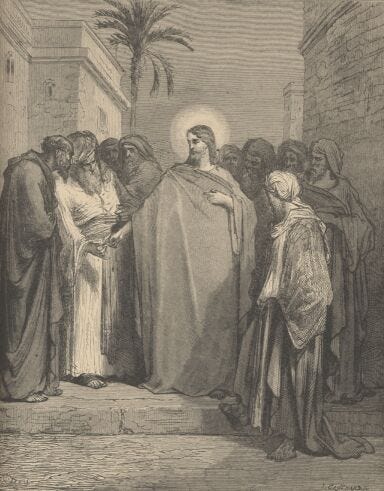
In Luke 20:27-38, in the lectionary for this week, we see a few examples of this principle in action. The scene is a familiar one, though the players are a bit unusual. In this passage we find Jesus locked in a discussion with other religious folks, which is a pretty common sight in the Gospels. But this passage is unusual in that it’s not Jesus’ usual sparring partners—the Pharisees—but instead Jesus is debating some Sadducees. (For a primer on some of the differences and the stakes of interpreting passages like these, check out my post from a couple of weeks ago). This is important, because one of the many things Jesus and the Pharisees agreed on was the resurrection of the dead; both Jesus and the Pharisees expected a future time when the dead would be raised. But the Sadducees—being the good traditionalists that they were—did not expect any resurrection of the dead. It’s not surprising that they would come and debate with Jesus on this topic. Here we have two groups of Jews, testing each other’s understanding of religion by offering test cases and playing out the implications of different ways of thinking.
Our first rejection of a premise, then—the first example in this passage of someone refusing the terms on which someone else presents an argument—is the Sadducees’ rejection of Jesus’ belief in the resurrection. We don’t have the first part of this conversation, but presumably this was not the first time Jesus and the Sadducees had had this discussion, and it wasn’t the first they were hearing of each other. They speak like people accustomed to theological jousting. So the Sadducees came informed by their past discussions and ready with a test case that would undermine the premise of Jesus’ position. They presented the case study, which was grounded in Torah teachings about inheritance and marriage. The short version of the law that the Sadducees were citing was this: when a man and a woman married, and the man died without producing a male heir, then it was the duty of the next-closest male relative (often a brother) to enter into a marriage (often called a “Levirate” marriage) with the woman, and any offspring of that Levirate marriage would be legally considered to be the offspring of the dead man. The Sadducees noticed, astutely, that such a situation undermined the premise of resurrection, which—again—they did not believe in. They told a story of a man and a woman who married, but the man died before having a male child, and in time all six of his brothers entered into Levirate marriage with the woman and then died in turn, as did, eventually, the woman. The Sadducees’ question was a good one: In the resurrection, therefore, whose wife will the woman be?
It’s a good question and a good test case, because it exposes the unspoken premise of the idea of resurrection, which is that life can be laid down and then simply taken up again without consequence. Life is full of customs, legalities, and arrangements that hold true during life and then change dramatically upon death. Marriage is one of them, but we could also think about property ownership, employment, or parental rights, all of which change or terminate upon death. Resurrection messes with that system. Imagine, for example, if someone who had left you an inheritance suddenly rose from the dead and wanted their money back. Or imagine if a child’s dead biological parent rose from the dead to reclaim legal guardianship. It would create a mess of logistical challenges (not to even speak of the weirdness of a bunch of formerly-dead folks clogging up the court system with property disputes). The Sadducees’ question basically begins by denying an unspoken premise of resurrection, which is that resurrection is simple and always a good thing. In the case of the woman and the seven brothers, they were saying, resurrection would make a mess of relationships and it would create as many problems as it would solve.
But watch what happens next: after the Sadducees pose a question that rejects the premise of Jesus’ position, Jesus next rejects the premise of the Sadducees’ question. Turnabout is fair play, I suppose. After the Sadducees had finished offering their case study, they probably expected Jesus to admit that he was trapped and concede their point, or else to argue on some technicality that allowed postmortem polyandry, or something like that. But instead Jesus identified the premise of the Sadducees’ question, which was that resurrection would naturally be an extension of life with all the same rules and conditions, and he rejected it. Those who belong to this age marry and are given in marriage, Jesus said, but those who are considered worthy of a place in that age and in the resurrection from the dead neither marry nor are given in marriage. Jesus says that the Sadducees had been all wrong in assuming that marriage would be meaningful to resurrected people, and in fact Jesus claimed that such earthly matters would be of little concern to someone who had been raised from the dead.
I have met enough married people to know that some would feel liberated by the idea that they would no longer be married post-resurrection, and others would be deeply grieved by the news. Marriage for some people feels like a gift of companionship and love and purpose, and for others marriage can feel like a prison. It’s interesting to think though how and why someone like Jesus—an unmarried man, as far as we can tell—would understand the highest state of being to be one free of interpersonal relationships like marriage. That is an interesting data point in its own right—that Jesus thinks that marriage is the kind of thing that will be left behind when life is renewed, or that the final form of humanity would be free of an institution like marriage.
But Jesus’ rejection of the Sadducees’ premise is effective, because it makes their question somewhat meaningless. The seven brothers, Jesus says, would be resurrected as unmarried men, and their relationship with the woman would be of no consequence any longer. And likewise the woman would enter into the resurrected life free of the seven brothers—a condition that one imagines she might embrace with some enthusiasm. She had probably had enough of her seven husbands, and she would probably have been looking forward to a resurrected life free of being obligated to any of them.
And that leads me to a third and final case of rejecting a premise that can help us interpret this passage. The premise of this passage, I think, is that the most salient fact about this woman is her reproductivity, and that the most important question about her life (and death) is someone else’s possession and ownership of her. The Sadducees rely on that premise when they tell the woman’s story in the first place; they tell the woman’s story entirely in terms of her reproductive partnerships. Nowhere in this passage’s consideration of the woman’s life and death and resurrection do her own desires or wishes make an appearance; she is locked in a cycle of marriage and widowhood that she likely had no control of. Jesus, in his response, largely accepts the Sadducees’ framing of the problem and the woman’s life, pushing back only on the question of post-resurrection marriage. Jesus also treats this woman as a passive recipient of partnership after partnership.
We could imagine a couple of different responses that Jesus might have made to the woman’s predicament and the Sadducees’ question. When asked whose wife will the woman be in the resurrection, Jesus could have responded with another question: whose wife does she want to be? Or, Jesus could have responded by giving essentially the same response that he gives in Luke, but centering the woman’s experience: in the resurrection from the dead this woman will be free from the expectation that she has to have sex with men until she gives birth to a male child. The premise of this whole interaction is that women are rightfully players in a drama of male heterosexual reproduction—that their bodies and free will can be conscripted into producing a male heir in order to further a patriarchal system. We can simply reject that premise. Nothing says that we have to accept that this is true, and nothing says that our interpretations have to be bound by the same vision of women’s (lack of) autonomy that both Jesus and the Sadducees seem to share. This passage is, I think, a wonderful example of how we can interpret scripture by arguing against it and pointing out the injustice that is often built into the text. We live in a drastically different time and place than the ones described by the Gospel of Luke, and we are not obligated to adopt the worldviews of the gospel-writers or even of Jesus himself. We do not have to accept their premises.
It can feel transgressive or risky to reject the premises of a biblical text, and to argue against the very framing on which the story is told. But probably not very many people alive today would argue that a woman should be obligated to marry and have sex with her dead husband’s six brothers. We would reject that out of hand in our own world, so there is no reason we should accept it for the purposes of reading scripture. We can read scripture with our own values and worldviews intact, and we should—we should bring the best of what we think and know to our interpretations of the Bible. And if that sometimes leads us to reject the premise on which scripture is based, then so be it.
I found your reflections on literal beliefs in resurrections enormously helpful.