Reclaiming Righteousness
Reflections on the Lectionary for February 8th

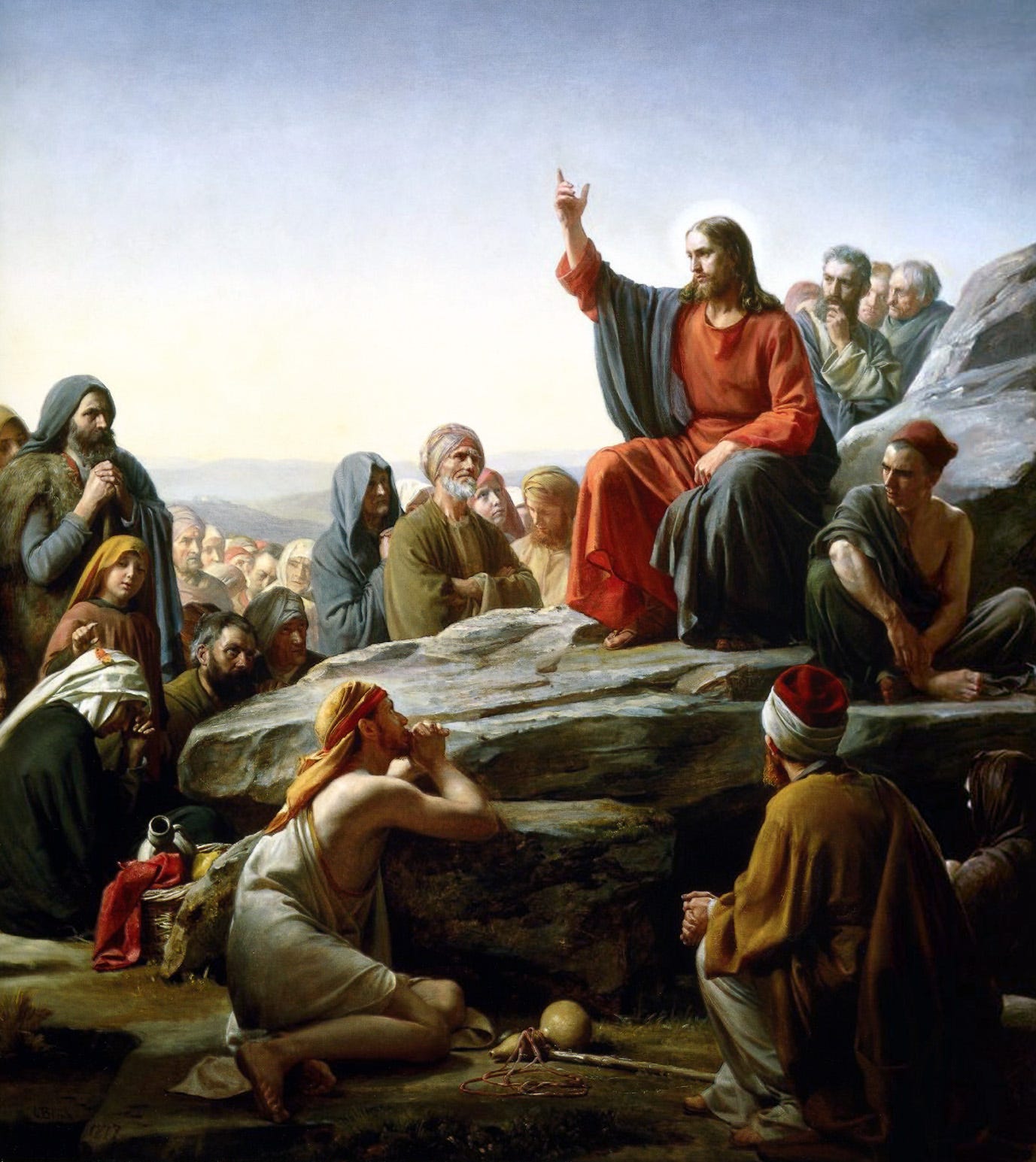
I am fascinated by the word righteousness. I think the fascination goes back to my evangelical days, when righteousness was thrown around as a catch-all word to describe the intersection of blameless behavior and pure intentions. I remember noticing the ways people would say righteousness to describe something both vague and specific: a standard that was hard to describe and therefore hard to attain, but easy to throw around as a goal or an ideal. It was a way to insinuate shame without having to shame someone out loud.
Although I am no longer part of the evangelical world, I do find myself returning to the word righteousness sometimes. I like to use righteousness in ways that cut against the grain of expectations. While when I was a young evangelical, righteousness often was used to describe sexual purity (you should strive to live righteously in your relationships, people would say, meaning that you should avoid expressing your sexuality in any way, or to describe ethics, as in God wants us to live righteously in the world, meaning that you shouldn’t listen to secular music but you should vote for “pro-life” candidates). So now I like to drop the word into similar kinds of situations, but in the opposite direction. The church ought to treat lgbtqia+ folks righteously, I might say, or the network of resistance in Minneapolis is protecting its neighbors righteously. I like the way the word plays against expectations, how it can reframe so-called liberal causes as examples of right behavior. I like the way righteousness points to a kind of ethical framework that somehow we think belongs to conservative Christianity, but which actually describes a wide range of actions in the world, even—and sometimes especially—ways that conservative Christianity would reject.
All that is to say that the word righteousness caught my eye in the lectionary readings for this Sunday. It appears in both the Isaiah passage and the passage from Matthew. Though the contexts for those two books are quite different, I think righteousness appears in each in ways that point to a common field of moral reasoning. That is to say, both Isaiah and Jesus in Matthew are interested in the question of right behavior, and they are both trying to work through what that might look like in the real world. Both are in conversation with ancient Israelite traditions of ethics, and both are frustrated with the ways ethics plays out in everyday life. And both, I dare say, are misunderstood by many Christians.
I want to start with Matthew 5:13-20, because I think it gets to the heart of Christians’ misunderstanding. In this passage—part of Jesus’ Sermon on the Mount in Matthew—we find Jesus’ well-known comparisons of people to salt and light. Jesus is making an interesting claim here, especially when we begin to imagine the audience of his words. If he was speaking to a crowd of peasants and lower-class people, as seems likely, then Jesus was making a radical claim about who makes for a good moral exemplar. (The you in this passage is plural in the Greek, so he is addressing the crowd and not any one person). Jesus was pointing to the kinds of everyday folk who had showed up to his hillside sermon, and calling them the salt of the earth and the light of the world. That’s already a remarkable thing to say, because it places the virtues of moral uprightness among normal people, and not among priests, scribes, or other kinds of especially holy people.
This is just the kind of thing that Christians tend to take the wrong way. Christians often read Jesus as an anti-elite religious reformer, and especially Christians like to read Jesus as someone who was opposed to the Jewish religion and its representatives. Passages like this one, which highlight the virtues of everyday people instead of the Jewish religious leadership, sometimes get interpreted as attacks on Judaism itself. Protestant Christians especially like to see themselves (and their latent anti-Catholicism) in Jesus, and they like to imagine him as some kind of anti-institutionalist, just like the heroes of the Protestant Reformation were.
But Jesus seems to anticipate this argument; he seems to realize that what he has just said could be interpreted as an attack on religious elites. And he immediately closes that door. Do not think that I have come to abolish the Law and the Prophets, he said, but I have come not to abolish but to fulfill. And then later, Jesus says, unless your righteousness exceeds that of the scribes and Pharisees, you will never enter the kingdom of heaven. Both of these statements are interesting for the way they defend traditional forms of Judaism, and both of them are fascinating for how they anticipate and push back against modern Christian arguments. Christians, for example, love to take shots at the Jewish Law, and they love to describe it as a hollow form of righteousness that was always bound to be eclipsed and surpassed. (I heard a version of that argument just this past week, in a sermon that was assigned listening for a class I’m currently taking). Christians seem to think that Jesus was proclaiming some new and previously unknown form of righteousness, unconnected to or even opposed to his native Judaism. But notice how—as Jesus describes moral uprightness and righteousness—he begins with the pillars of Judaism itself. The Law and the Prophets refer to major collections of Jewish religious wisdom, that we now know as parts of the Hebrew Bible or Old Testament. While it is common for Christians to assume that Jesus meant to replace those things, here he is insisting that far from abolishing them, he is here to fulfill them—to make them whole.
When Christians want to make the argument that the Jewish Law is defunct or has been surpassed, we usually turn to our favorite straw man, the Pharisees. Christians (informed by the New Testament’s skewed descriptions of them) have long understood the Pharisees to be the paradigmatic Jews: hypocritical, hollow, and misguided. Pharisees, in the Christian imagination, are unrighteous precisely because they claim righteousness while being disingenuous about it. But here in Matthew 5, Jesus holds the Pharisees (and the scribes) as exemplars of righteousness and morality. They are the standard that must be met and exceeded if a person wishes to enter the kingdom of heaven. Far from dismissing Pharisees as false or misguided, Jesus holds them up as examples of righteousness. And far from casting the Law aside, Jesus holds the Law up as the endpoint of his own life and teaching.
Turning to Isaiah, I will make one more point about Christian misconceptions about the Law. Christians often think that we—and Jesus especially—were the first ones to ever notice that legalism can be restrictive, and that true righteousness can sometimes happen outside the Law. But that’s not true at all; Judaism is full of examples of people understanding that the Law is a structure and a guide but not a straitjacket. Jesus, in this regard, was just following tradition.
Look at Isaiah 58, for example. This is a passage, broadly speaking, that is about righteousness; it is about the right ways to live and behave. The passage is dealing very broadly in categories that the Jewish Law recognizes and speaks to—things like justice and injustice, oppression and freedom, evil and good. But this is not a legal text; it is a prophetic text. Isaiah is not interested very much in the letter of the Law; Isaiah is interested in the broad effect of the Law and the kinds of moral reasoning it engenders. Isaiah takes religious legal ideas like fasting and turns them into metaphors: Is not this the fast that I choose: to loose the bonds of injustice, to undo the straps of the yoke, to let the oppressed go free, and to break every yoke? Further down, Isaiah suggests offering food to hungry people and satisfying the needs of the afflicted, and he understands that to be the necessary first step towards God’s restoration of Israel. Isaiah, centuries before Jesus and the Pharisees, understood the Law as a starting point but not an ending point; both Jesus and the Pharisees were simply carrying on an old tradition. Isaiah is interested in righteousness broadly speaking: Yet day after day they seek me and delight to know my ways, he writes, as if they were a nation that practiced righteousness and did not forsake the ordinance of their God; they ask of me righteous judgements; they want God on their side. The ordinances matter, but as Isaiah goes on to say, righteousness consists of the living out of those ordinances.
That perspective—which I also think lies at the heart of Jesus’ comments in Matthew 5—can inform Christians’ search for an ethics to live by. Neither Jesus nor Isaiah reject legalism or legal texts; they both see the Law as essential. But the Law is not the same thing as righteousness, and both Jesus and Isaiah are looking for righteousness. Both Isaiah and Jesus are interested in the ways broad legal ideas inform the living of everyday life, and the ways they intervene in the questions of justice and injustice that crowd around us.
Certainly plenty of injustice crowds around us today. Certainly our world could be improved if we all paid more attention to righteousness. But righteousness isn’t a question of rule-following and blameless behavior, in the way people used to use it when I was a young evangelical. Righteousness isn’t concordance of do-and-don’t. Instead, as both Isaiah and Jesus recognize, righteousness is about doing justice and living rightly in the world. Righteousness is an orientation toward setting the world right, toward freedom and liberation, and toward ending oppression. And in that sense, there is still plenty of room for more righteousness in our world.
Your reflections on righteousness are so helpful for me right now. Whenever I hear texts and music referring to righteousness I experience religious struggles and lament for those whose suffering could be condemned by religious authorities. It's enlightening and comforting to read your reflections before going to church this morning, where there will be texts, music and reflections on righteousness.