Persistence and Springtime
Reflections on the Lectionary for the Fourth Sunday of Lent

I am generally not a believer in the more supernatural-ish or miraculous aspects of Christianity. I don’t say that to cast aspersions on anyone who does believe those things; I don’t any longer get very vexed by people putting stock in things that I don’t. I don’t believe in (or care about, really) the virgin birth, for example, and it’s not really important to me whether and how miracles occur. I’m not denying those things exactly—it just does not matter very much to me. When it comes to those sorts of questions—even though I’m a New Testament scholar and an ordained minister—my positions are not really distinguishable from a non-theistic rationalist.
But the one place where my theology (or perhaps my metaphysics) gets a little woo-woo is when it comes to death. Having experienced the loss of a number of people who are close to me, including friends and close family members like my father and all four of my grandparents, I believe in some form of persistence after death. I don’t put a lot of time or energy into reconciling this seeming discrepancy, or trying to make it make sense. It’s not something that I feel the need to explain. Rather, my belief in presence beyond death is something that I feel instinctually, or maybe that I simply trust in some sense. It feels like it’s true, or that it ought to be true, and that’s good enough for me. I don’t think we all go to live on a cloud somewhere, but I also don’t think people simply disappear when they die. I don’t expect to ever see my father again, for example, but I do feel him around, sometimes. I don’t think I’m going to hang out in heaven with my grandmothers—though I would very much like to—but I don’t experience them as absent, either.
But sometimes I find myself wondering if this is a form of self-soothing. Perhaps, I find myself thinking, I believe it because it’s comfortable to believe it. Perhaps I sense the presence of departed family and friends because I want to sense their presences, and it feels good to imagine that I do. That’s certainly possible, and if that turns out to be what’s going on, that’s fine with me too. One thing I’ve learned from professional therapists is that there’s a lot to be said for doing what works and sticking with what’s effective. If death is an abyss that we all teeter over and eventually fall into, and if it helps me to entertain a vague hunch that it’s not just darkness all the way down, then why not do it? If death passes through all of our lives, why not find ways to cope with it? If that’s what’s happening, then I love that for myself.
The lectionary for the fifth Sunday of Lent is all about death. All four passages begin with experiences of death (or thereabouts), and they all wrestle with it differently. Ezekiel has a vision of a valley full of dry bones, and then watches the bones reassemble and come back to life. Psalm 130 begins with a cry out of the depths, continues with a soul in waiting and hope, and concludes with the idea of redemption. Romans 8 contemplates the distances between flesh and its death on the one side and Spirit and life and peace on the other. And John 11 is the grand and pathos-filled story of the raising of Lazarus. In all four of these passages, death is lurking, but in Ezekiel and John, death is in full view, already on the scene. And in those two stories, it is not only death that is on the stage, but life too, because in both Ezekiel’s vision and John’s raising of Lazarus, the plot turns on the ways death is thwarted. Death does not get its due in the valley of dry bones, because the dry bones join together and re-form into bodies that become covered in flesh, and the bones live again. And in John’s story, even though Lazarus is well and properly dead (Lord, already there is a stench, as Martha put it), Jesus calls him out of the tomb and Lazarus stumbles out again into the light.
Lots of people turn lots of cartwheels, trying to make stories like these not say what they clearly say. Ezekiel is easy to dismiss because it’s a vision; it’s not meant to describe reality. The valley of the dry bones is easy to chalk up to metaphor (even though such valleys full of bones likely existed, in the wake of violence and war, and it might have been harder for ancient readers to dismiss the realities of a vision like this one out of hand). But John 11 is clearly intending to tell the story of an actual death and an actual resurrection. It’s not a metaphor (or it’s not only a metaphor); the stakes are life-and-death. So, people sometimes argue that Lazarus was not really dead, in some way or another. Perhaps he was in a coma, they say, or only pretending to be dead, or some other circumstance. They do the same thing for Jesus’ resurrection, too, claiming all kinds of things about the appearance of death or the theft of corpses. Because I’m not very invested in the miraculous, I’m not very interested in those scientific or medical or logistical explanations. I think John is trying to tell the story of a man who died and was raised again, and I think all four gospels were trying to tell stories about Jesus crucified and risen. Ancient people weren’t modern scientists, but they weren’t stupid either. They knew death very well, probably much better than we do, because they lived life in its shadow. John 11 is trying to describe a rupture in the normal order of life and death, and Ezekiel grounds his vision in the very real experiences of traumatic loss to violence.
So I’m left with a bit of a conundrum. I believe that Ezekiel and John (and Matthew and Mark and Luke) meant what they wrote down. I don’t think they were fooled into misunderstanding the way death worked. They were describing experiences of life after death, even if in the case of Ezekiel those experiences were had in the world of visions. But at the same time, I don’t really go in for all that supernatural miraculous stuff. I believe that they believed it, and that they had experiences of resurrection, if that makes sense, but I’m agnostic at best about whether or not dead people actually came back to life. That leaves me in the lurch a little bit, theologically, because I’m neither interested in affirming nor denying these stories. I don’t think dead people come back to life. But I do think dead people persist, in some way that I can’t understand or describe.
Theologically, resurrection is the central claim of Christianity. Sometimes this bothers me. Reading through the gospels, it sometimes feels like the story of Jesus is a bait-and-switch. For the first three-quarters of the story, Jesus is a teacher, a prophet, and a miracle-worker. He’s going around preaching the immanence of the Kingdom of God, throwing subtle shade at all kinds of power structures, and offering a fairly radical alternative way of life. And then at the end, it becomes a story about a supernatural miracle—a story about someone rising from the dead. I sometimes struggle to figure out what those two parts of the story have to do with each other. What was the point of all the moral teaching at the beginning, if it’s just going to turn into a miraculous escape from death? Why do the parables, the Sermon on the Mount, the healing stories, if it all comes down to history’s biggest plot twist? I think there are ways to bridge those two arcs and read the story coherently: death, like empire, is a power that needs to be overcome, or something like that, and both healing and resurrection are ways to talk about flourishing. But if you read the writings of the first extant interpreter of Jesus’ life, who is Paul, then you see that Paul very much got the message from Jesus’ life and death that the resurrection was the main event. Paul hardly mentions any of Jesus’ teachings or activities while he was alive; it’s like Paul didn’t know anything about them (which tells us that Jesus’ teachings weren’t an important part of the tradition Paul received about Jesus), or he didn’t think they were relevant (which tells us something important about the way Jesus’ teachings were received—or not received—by his followers after his death). Very quickly after Jesus’ death and resurrection, the moral content of Jesus’ life—and even just the narrative content of it—took a back seat to the cosmic implications of his rising from the dead.
It’s interesting, putting Ezekiel’s vision of the dry bones together with John’s story of the raising of Lazarus, as the lectionary does this week. I think it’s interesting because the juxtaposition gives us two different options for how to think about persistence after death. John’s story, as I said above, is clear that this is a dead person who was brought back to life. It’s more than a vision and it’s more than a metaphor; John wants us to know that it was a sign (in John’s characteristic language), or a miracle. Ezekiel’s story, though, lives in the realm of vision. We are not supposed to imagine real people in this story; the dry bones are not individuals but a collective symbol. No one is picking out their neighbors from the assembled and reassembled flesh in Ezekiel, but John makes it clear that Lazarus was a friend to both Jesus and his disciples, and well known to many.
The vision of the valley of dry bones, then, feels like a good fit with my hunch that people persist after death. It makes sense to me as an expression of the feeling that the dead are not wholly absent, and that we can experience their presence sometimes, and that what is dead can find new life. (More on this in a moment).
But the story of Lazarus somehow goes too far. I think it’s too explicit for me, too on-the-nose, too hocus-pocus. If I had been the person writing the Gospel of John, I might have said that Jesus visited Lazarus’ tomb, and that afterward Mary and Martha and Jesus and his disciples all felt sometimes like they heard Lazarus’ voice in a crowd, and sometimes Martha thought she saw her brother out of the corner of her eye, and sometimes Jesus spoke with Lazarus in dreams. Maybe Peter suddenly remembered one day something Lazarus once said and smiled; maybe Mary saw Lazarus’ features in the face of a nephew. That feels truer to me—and honestly, more hopeful—than the resuscitation of a dead man. I don’t experience the dead in some Uno reverse-card, reverse-the-timeline form, and I don’t really think I want to. I experience the dead as a presence, as a form of comfort, as a suggestion and a memory and a glimmer and a reflex.
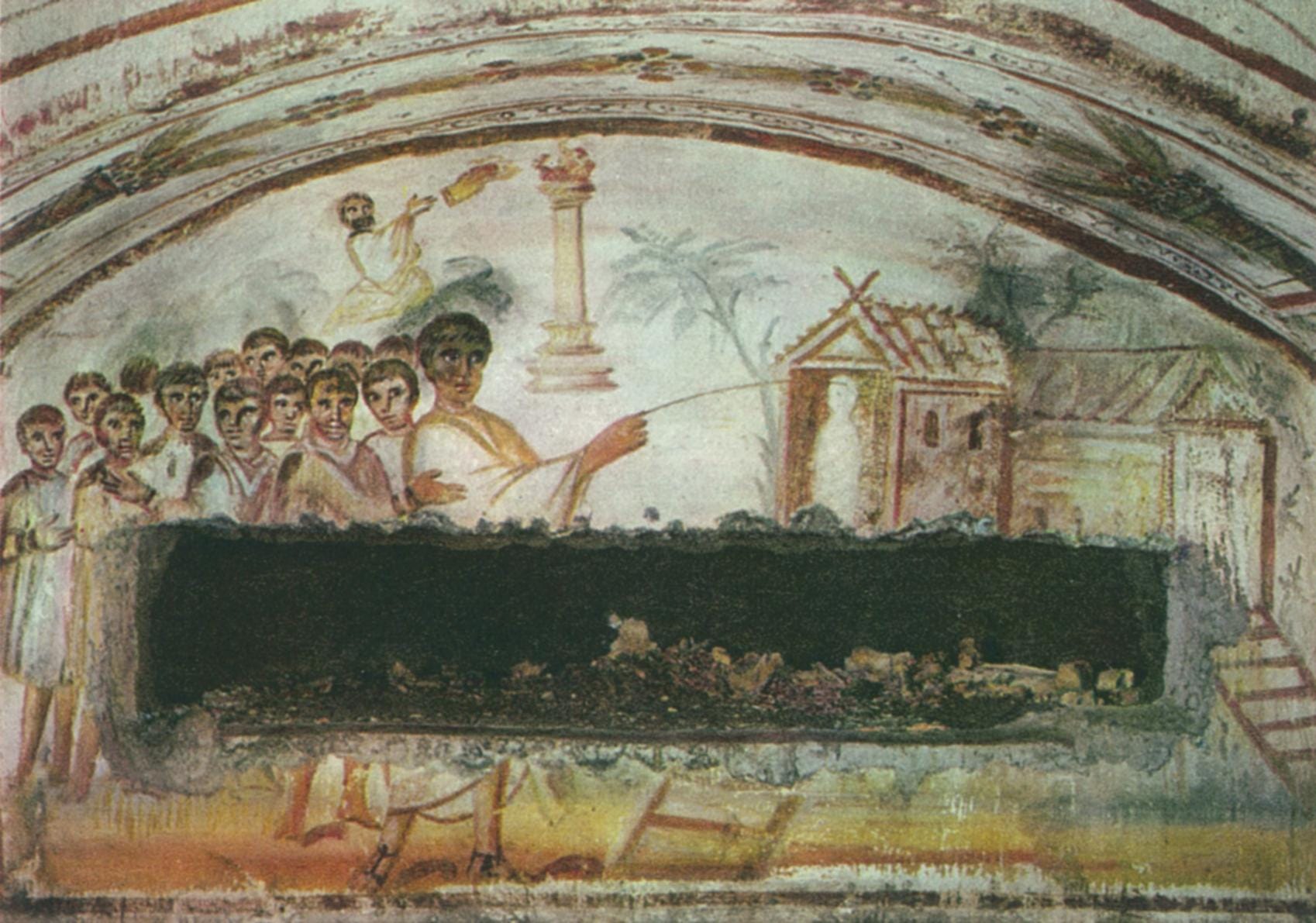
Every year as we approach Easter, I find myself feeling grateful that it comes in springtime. Where I live on the eastern edge of the Rockies, spring is only just beginning this time of year, and most of the trees are still bare. Some of the trees have started to bud and some of the perennials have started to push through the soil, but mostly everything is still asleep. The world this time of year always reminds me that dormancy is not the same thing as death, and that life has a way of staying hidden until it’s time. You can trust that it will all come to bloom eventually, but you can’t say some magic words or wave a wand and make it happen on command. (Notice, in the painting up top, that Jesus wields a staff or wand as he calls Lazarus out of the tomb. Most ancient depictions of this story look like that, and although it’s not a magic wand in the modern pop cultural sense, it does always make me smile and chuckle to see it). Rather, the world turns at its own pace, and life blooms and goes dormant in its own cycles, and something’s always alive somewhere, even if it doesn’t look like it. That seasonal perspective feels right to me, much more than anyone’s body rising from the dead. I’m glad Easter comes in spring, when I’m already reminded constantly that life always sits right beneath the surface, ready to break forth.
So interesting to learn your thoughts about death. Thanks for sharing these personal reflections.
Once again, thank you. It has always bothered me that I can't accept someone rising from the dead as the central tenet of my faith. And Jesus didn't stay very long, either. Your thoughts make me feel not such a heretic. And also for suggesting tolerance for others who find the resurrection so central. I will try.