Kinkeeping
Reflections on the Lectionary for June 14th

I spent Saturday traveling. I started the day at my mother’s house in western North Carolina, where I had been staying with her for several days. And I ended the day in southeastern Tennessee, where I am spending the first half of the summer in a creative writing program. Those two places are not very far away from each other when you look at a map or a satellite image, especially if—like me—you had just spent a couple of days traveling half the continent on the way from Colorado. But unlike the journey from Colorado to North Carolina, which involves crossing great swaths of plains and open horizons at 80 miles per hour, my Saturday travels were complicated by high mountains, gnarly rivers, remote locations, and questionable infrastructure.
My phone’s mapping app gave me three options, and all of them were compromises. The first fastest route led me along I-40 across the North Carolina-Tennessee state line—a path I have driven hundreds of times in the past. But Hurricane Helene devastated that road a couple of years ago, and it’s still a work in progress, with traffic frequently backing up in the one lane that’s open in each direction and prone to interruptions from lumbering construction equipment. The second route, which was the simplest, added about an hour, but it took me all the way south to Atlanta before sending me back north again. I opted for a variation on the third middle path, which was neither fast nor simple but which offered me the opportunity to visit with my ancestors—which let me do a bit of what I sometimes call kinkeeping.
My phone’s version of the middle path would have had me take I-40 as far as Cullowhee and then cut southwest into the mountains, but instead I decided to modify it, and take an old route that I know like the back of my hand. That way begins in Asheville and dives southward to the town of Brevard, and then takes hairpin winding roads up into the high mountains where my mother’s people are from. Today, the town of Highlands is a tourist destination, full of shopping and world-class golf courses, but my family has been in that area since before the days of paved roads and indoor plumbing. I pointed my Jeep that way, remembering that Jeeps were never meant for taking corners at speed, and I drove past the landmarks of my childhood. I recognized the stone-faced mountain where I once hiked with my grandmother, and a high-end hipster reclamation-and-salvage building supply shop built on the spot where there used to be a strawberry field where my mother and grandmother made me wait in the car while they picked berries. I saw the place along the twisty road where we would pull over to let my carsickness-prone brother throw up, and the storefront where there once had been a book shop where my great-aunt and great-uncle once let me buy any book I wanted, and the old brick Baptist church where generations of my family had attended and married and buried, and where the same great-aunt and great-uncle had once taken me to a Wednesday night Bible study class. (I remember loving that Bible study in a way that was strange for a six-year-old—perhaps a sign of things to come). But my destination on Saturday was not any of those places. I was heading somewhere I had never been before.
I pulled into the Eckerd Living Center, which is a long-term rehabilitation facility. I was there to see my great-aunt—the same one who had once taken me to the bookstore and the Bible study. Her husband, my great-uncle, passed away several years ago, and now recently my great-aunt had fallen on her front steps and broken her hip. This was why I had come through Highlands in the first place: to see her. Nearly all my other relatives of her generation are gone now, but I knew she was there in her rehab room, so I wanted to say hello. I was worried that she wouldn’t recognize me out of context, but she did, and went spent a lovely thirty minutes catching up on my kids and my career and her prospects for going home soon (which are very good). My great-aunt had always been like a bonus grandmother to me, and it did my soul good to get to see her.
As I finished my visit with my great-aunt, I realized that I was only a mile away from the spot that we always called the old home place. This was the piece of land where my great-grandparents had built the home where my grandfather grew up, and where my grandparents later built their own home just up the hill and across the creek. When my grandmother became too frail to live alone and moved in with my mom, she sold the property, first her house and then the land where the long-gone older home of my great-grandparents had once stood. We did not own the old home place any longer, but I still felt like it was mine somehow, and I knew I would not have another opportunity to be so close for a long time, so I drove in that direction. The old gravel road is roughly paved now, but otherwise everything is still exactly as I remember it from my childhood visits in the 1980s: the mailbox, the teetering pine tree, the busy creek, my great-grandmother’s flower beds gone to seed but still popping up each springtime, forty years on. The wooden walkway still spanned the way uphill to the front door, looking as weathered as always. I looked around for a moment, and I sighed a deep sigh, remembering everything that had happened in that place, both in my own life and in the long years my family had lived there. Having made my pilgrimage, I plugged my Tennessee destination into my car’s GPS and headed on my way. That wasn’t quite the end of my time with my ancestors; I had another hour of driving past landmarks and place-names that were central to the lore of my family. But as I drove west toward the state line, I carried a keen awareness that I was concluding my visit with my ancestors, and leaving them behind.
That’s a long-winded introduction to an idea that many people might recognize: that attending to our ancestors is an important part of a lot of our lives. It’s not universally true, of course. For some of us, our ancestors are best forgotten and left in the past. But for me, and for many others, the practice of visiting (literally or figuratively) with our ancestors (living or dead) is a key way to make sense of who we are. It’s one of the main ways we reflect on ourselves and make choices about what kind of person we want to be. For me, geography and ancestry are intimately connected (as an ongoing book project will demonstrate, if it ever makes it to the light of day), and placehood and peoplehood are really two sides of the same coin.
Placehood and peoplehood are certainly central to the stories found in the Hebrew Bible. As I said in last week’s post, while we often think of the Bible as a book about religion or theology, it is really a book about land and people, and when it comes down to it, the Bible is very often a book about visiting ancestors—a book about kinkeeping. The Hebrew Bible got its start as a kinkeeping exercise, as generations of Israelites collected and edited and codified the stories of their own ancestry and their relationship with the land. The Hebrew Bible usually assumes a shared peoplehood on the part of its audience; it assumes that the reader is an Israelite who is connected by familiar bonds and by contemporary investment to the stories of shared ancestors. The stories of those ancestors—people like Abraham and Sarah, Jacob and Rachel and Leah, Moses and David and Ruth and Naomi and the prophets and all the rest—make up the backbone of what we now know as the Bible. And the Bible assumes that the reader’s investment in those stories is an investment in their own kinship, ancestry, peoplehood, and selfhood.
That assumption has gotten more complicated as the readership of the Bible has spread beyond Israelites. Today, contrary to the assumptions of the Bible’s authors, most of the Bible’s readers are not Israelites at all, but they are Christians. While the stories of the patriarchs and matriarchs of Israel were written and collected under the assumption that the people consuming those stories would have a personal, familial investment in them, that no longer holds true. The stories that were intended as personal and ancestral are now treated theologically by most readers, and the language of kinship that the Bible is treated symbolically rather than literally. I can remember singing the song Father Abraham as a kid, and I can remember the song’s claim that he had many sons, and that I am one of them, and so are you, but I always heard those lines with a kind of universalist and generic meaning, and no one ever tried to convince me that I was genetically connected to Abraham or anyone else. That wasn’t an important part of the story. That strikes me as a pretty big interpretive difference between Christians and Jews, between Israelites and non-Israelites, and between the readers that the biblical authors imagined and the actual readers that the Bible attracts today.
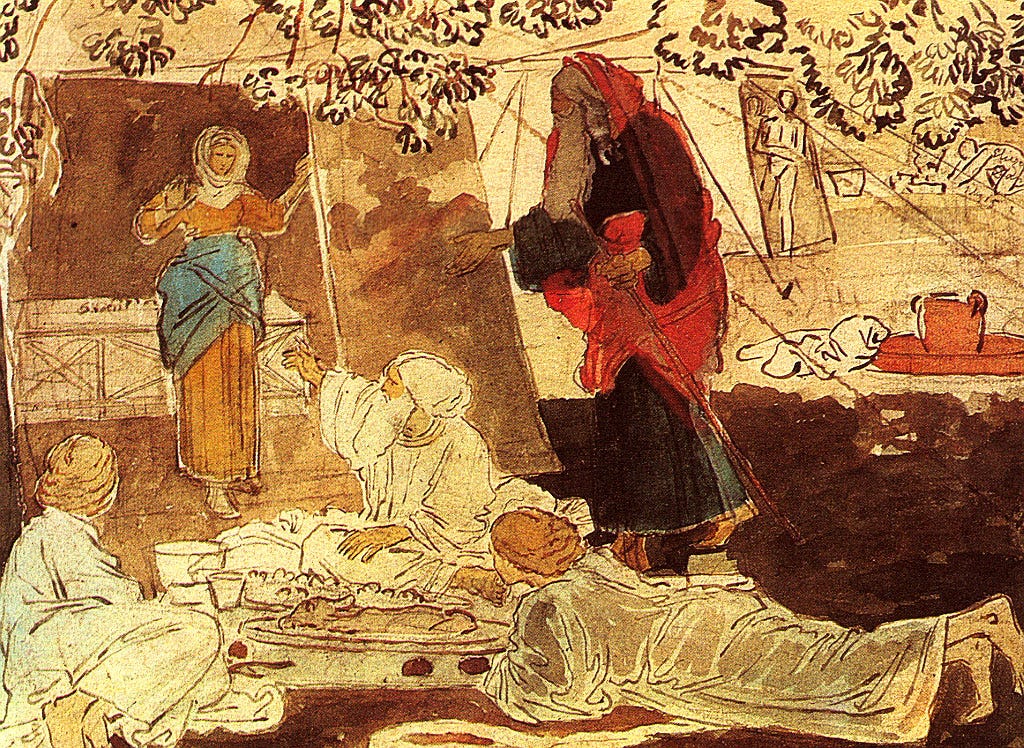
The lectionary for this Sunday includes one of the iconic stories of Israelite kinkeeping. This is the story of the visit of three men (angels? gods?) to Abraham and Sarah. It’s such a marvel of a story, the way so many stories from Genesis are, because it’s so oblique and opaque. The story itself is not very interested in telling you what it means; this passage simply gives the reader a scene and leaves it at that, without belaboring the meaning. The scene looks like this: Abraham and Sarah were at home, and three men appeared. Abraham showed the men an appropriately intense form of hospitality (or, rather, he enlisted his wife and slaves to show them hospitality), and one of the men made a prediction that Sarah would conceive a child and give birth. And Sarah, who was eavesdropping, laughed at the idea, and one of the men—now called the LORD, or God’s personal name in the Hebrew—had a little back-and-forth with Abraham about it.
That’s the end of the story (though the lectionary has an optional extension to the reading that picks up three chapters later, after the intervening account of the destruction of Sodom and Gomorrah, in which Sarah does in fact have the baby, and they name him Isaac). The story of the three men’s visitation to Abraham and Sarah, like so many stories from the Hebrew Bible, is suggestive and full of gaps. Who were the three men? Why does one of them get called by God’s name? If one of them was God, who were the other two? Did one of the men cause Sarah’s pregnancy, or did they simply predict it or notice it? Why such a focus on the details of hospitality? Genesis is not interested in answering any of those questions, at least not in any straightforward way. Rather, the story unfolds like a visit with ancestors, noticing little details, recounting the way lineages were established, and dwelling on the question of how the past contributed to the present and the future.
This is how Genesis, and indeed the whole of the Hebrew Bible, often treats its stories about ancestors. The Hebrew Bible is not necessarily interested in making overt meaning from the lives of these people, and it rarely pauses to be didactic about it. Rather, the Hebrew Bible visits with the people and the places that were important to the practices of kinship, and it offers vignettes of the lives of those relatives, and then it moves on. In some ways, this is an incredibly important story in the narrative of ancient Israel, because without this pregnancy—without this child Isaac who was born from this moment—there would have been no nation of Israel at all. But Genesis does not stop to lecture the reader about that. The story will be revisited and recounted elsewhere in the Hebrew Bible, because it was important that the people knew it, but there was no need to spell out everything that it meant. The meaning was in the story; the meaning was the visitation and the kinkeeping.
Today, many Christians theologize a story like this one, and we turn it into an example of God’s faithfulness, or a parable about the way kindness and hospitality receive divine reward. But in its first contexts, when the readers (or hearers) were Israelites, this was a story about kinship, and it was a saga about ancestors. The meaning didn’t need to be spelled out because the meaning—such as it was—was embedded in the telling of the story itself. Stories about ancestry—stories about the past—mean because they explain the present, and they mean because they anticipate what kinds of lives we will live in the future. Genesis is telling this story about Abraham and Sarah not because it means this thing or the other, but because without it a whole saga of peoplehood would make no sense. This story is a practice of kinkeeping.
Sometimes I think about how I’m living out the stories that my own kids and descendants might one day tell. Sometimes I catch myself remembering that I’m living out someone else’s lore. It’s a weird and dizzying sensation, to realize that I might end up as someone’s ancestor, as a collection of stories that help them understand who they are and how they got that way. I suppose that I hope that’s what happens—I think I’m hoping that my life means enough for someone else to tell stories about it. But in the meantime I’ll keep my own stories, and I’ll visit with my own ancestors, and I’ll make meaning out of the experiences that I have had and the places and people that have been important to me. Genesis is one of those stories, for me, that carries meaning and tells me something about who I am, stretching all the way back to moments like that Wednesday night Bible study that my great-aunt took me to at that small mountain Baptist church. Genesis isn’t a book about my ancestors, but it does tell me something about myself, and its strange and sideways stories help me understand my world a little better. Improbably, Genesis is a character in my own kinkeeping—a piece of the story I tell. If you’re reading this, then the same might be true for you. The question for us is: what kind of meaning do we make of a story like this one?
The introduction about your personal kin keeping travels reads a lot like creative nonfiction I have read. Will look forward to your opinion on what new things you learn this summer. Your view that "the story is the story" reminds that understanding the story is perhaps the first and most important thing. Understanding the story,if one can, is more than enough. Nice of you to take us along for your trip.