Jesus Scoring Points
Reflections on the Lectionary for the Second Sunday of Lent

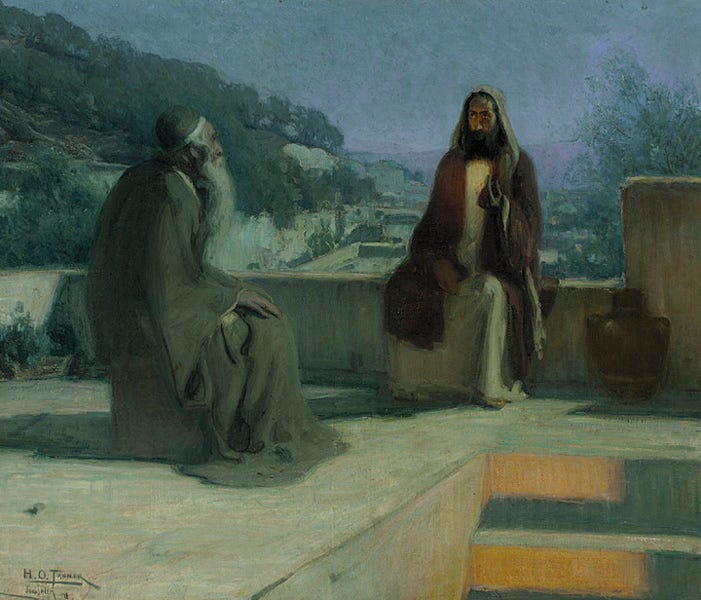
The story of Nicodemus, which is in the lectionary for the second Sunday of Lent, is usually thought of as a referendum on Nicodemus himself. It is usually read as a firm and thorough critique of Nicodemus and his role as a Pharisee…a leader of the Jews, whose encounter with Jesus is supposed to have shown him to have been less impressive than his credentials would suggest. The basic structure of this argument is that a) Nicodemus comes to Jesus by night, suggesting a certain reluctance or bashfulness or shame about interacting with Jesus, b) Nicodemus’ misunderstands Jesus’ words about being born from above, showing that Nicodemus is not as astute a teacher as Jesus and didn’t fully understand his own religious tradition, and c) Jesus outright rebukes Nicodemus in verse 10, where he accuses Nicodemus of not having the proper amount of understanding that might be expected or demanded from a teacher of Israel.
When we read it that way, this passage becomes a story about Jesus’ critique of Jewish leadership and religious understanding. It becomes an opportunity for Jesus to tee off on a Jewish leader, to assert that Nicodemus (perhaps like other Jewish leaders) is not as learned or spiritually astute as he should be, and most importantly to show Jesus’ own superiority. It’s not an accident that this story appears only in the Gospel of John; John’s gospel consistently portrays Jesus as smarter than everyone else and generally operating on a different plane than the rest of the people in the story. And John tends to have strong anti-Jewish undercurrents. This is a very Johannine story, in that sense; it’s a little drama that plays out for the purposes of demonstrating Jesus’ superiority, wisdom, and otherworldly understanding.
That traditional reading of the story of Nicodemus is so pervasive as to be the only real reading of this passage, for many people. If you have heard this passage interpreted, you’ve probably heard a version of that analysis. But that interpretation is not without its issues. Perhaps the most prominent problem with the traditional interpretation is that it slides very easily into anti-Jewish or anti-Semitic rhetoric. Although John 3:1-17 tells the story of two Jewish leaders (Jesus and Nicodemus) hashing out the finer points of being Jewish teachers, the traditional reading turns this into a conversation about Judaism and Christianity. It makes Jesus an avatar of Christianity, and it has him demonstrate the insufficiency or inadequacy of Judaism and Jewish teaching in a way that leaves little room for nuance. Jesus is a heroic Christian teacher, who entertains a Nicodemus too bashful to show up in the daytime, teaches him a thing or two, and dismisses him as unworthy.
That interpretation fails on the basic level of taking the text seriously, because it fails to account for the fact that both Jesus and Nicodemus held roles in the same religious and political and national associations, and that they met that night as equals, or that if anything Nicodemus was the party with more prestige. It also fails to account for the authorial perspective of John, which is of course biased toward showing Jesus’ coherence and authority, and which furthermore always shows Jesus as a commanding and correct force in the world. The result is an anachronistic view of the interaction which understands Jesus to have not only shown Nicodemus up, but to have shown that the whole enterprise of Judaism is based on shallow misunderstandings—textbook supersessionism and anti-Judaism.
What happens if we read this passage differently? What happens if we stop assuming that it was a conversation between representatives of Judaism and Christianity, and start taking seriously the idea that it was a conversation between two different Jewish people who each held a certain amount of authority in that system? I think it’s always worth flipping our reading around to see what else might be possible. It’s always worth asking what else might be true.
If we flip the interpretation and read it that way, the first thing we notice is that Nicodemus’ incredulity takes on a different tenor. The whole interaction between the two men (much like the interaction between Jesus and the Samaritan woman at the well in the very next chapter of John, which is the companion story meant to be read alongside this one) rests on Nicodemus approaching Jesus with a degree of respect. Rabbi, Nicodemus begins, we know that you are a teacher who has come from God; for no one can do these signs that you do unless God is with this person. Nicodemus shows up expecting that Jesus is already tightly connected to God, and prepared to encounter Jesus as a colleague or fellow-traveler, even though Nicodemus likely held more status. Jesus’ response, though, was intentionally confusing (just like his response to the Samaritan woman will be in the next chapter). Very truly, Jesus says apropos of nothing, I tell you, no one can see the kingdom of God without being born from above. The Greek word for from above is anothen, which confusingly also has the meaning of again, or a second time. Perhaps Jesus’ use of the confusing word was intentional, because he wanted to convey some nuanced meaning that relied on both definitions. But if that’s the case, the ensuring conversation is hard to understand. In 3:10, after some back-and-forth in which Nicodemus tries to understand what Jesus could possibly mean by his confusing statement, Jesus accuses Nicodemus of ignorance and professional malpractice. Are you the teacher of Israel and you do not understand these things, Jesus asks? But the misunderstanding was not a result of Nicodemus’ lack of theological sophistication, but of Jesus’ confusing word choice.
This dynamic might be familiar to anyone who has been a teacher, a minister, or someone else in a position of knowledge and authority, like Nicodemus. There’s a dynamic in those roles where sometimes people come to you with a question, and the question is obviously some niche thing that is designed to trip up the expert. What looks like an innocent question is actually a trap, or a gotcha. Physicians get gotcha questions about vaccines, teachers get gotcha questions about obscure historical events, and ministers get gotcha questions about creeds or doctrines. Musicians get encounters that are clearly designed to push a conversation toward a certain outcome, and policy experts get encounters designed to back them into a corner on some question of politics. Many people in fields with high prestige tend to have experiences like these, and it’s worth mentioning that they are often gendered, with men challenging women on their expertise and knowledge in a way that reveals that they never considered the woman’s expertise valid in the first place.
I got an email like this just yesterday. Do you ever teach about Romans 1, the email asked? It seems like an innocuous enough question, because I am in fact someone who teaches and preaches about the New Testament all the time. Yes, I teach about Romans 1. But there’s an agenda hidden inside that question. Romans 1 (and specifically Romans 1:26-27) is one of the infamous clobber passages in the Bible, which are purported to contain teachings about homosexuality (though the case is not nearly as clear as people think). So, this person was not actually interested in learning my thoughts on Romans 1, and they weren’t genuinely interested in learning at all. Rather, they were probably going down a list of people who work at progressive Christian institutions and trying to pick a fight with one of them. And likely, they were probably trying to produce a paper trail that they could screenshot and then post as evidence of liberal apostasy, or something like that. It was not a good-faith invitation to teach someone something, and it was not even a good-faith invitation to dialogue. It was a trap, disguised as an innocent question. I get these all the time.
There’s a way to read the interaction between Jesus and Nicodemus that way, I think. When I read their interaction, I get the sense that Nicodemus was an established authority with a lot of clout in the system who was approaching Jesus with respect and openness, and Jesus took the opportunity to score some points. (Or, perhaps it is better to say that the Gospel of John took the opportunity, since Jesus wasn’t the one who published the conversation). The way the conversation is reported, Jesus wasn’t talking like someone who was trying to be understood. He wasn’t clarifying the confusing parts of his language, and he wasn’t responding to Nicodemus’ responses with helpful additions. Instead, he let Nicodemus ask a few clarifying questions, declined to be more clear in response, and stuck to his unclear language to the end. Jesus comes across as a bit of a troll here, I think, and he’s engaging in what teenagers (who always have the best words for things) would call aura farming. He’s trying to improve his own status and appearance by staging an inauthentic interaction with an expert. Or—at least—the Gospel of John is doing that on Jesus’ behalf.
It was an effective strategy, because 2000 years later Christians are still reading this passage as evidence of Jesus’ superiority over Jewish teachers like Nicodemus. Twenty centuries on, we still hear sermons about how dense Nicodemus was, and how much more brilliant Jesus was by comparison. But we don’t very often pause to notice how the whole interaction was staged to make us come to that precise conclusion, and how its placement in the Gospel of John was never meant to give Nicodemus a fair chance. The whole conversation was a setup, designed to let Jesus show off his brilliance, like a rookie dunking on an All-Star in his first time on the court.
We will see a different version of this same dynamic next week, when the story of the Samaritan woman at the well will be the gospel reading for the third Sunday of Lent. The framing of the story will look a little different there, but the same dynamics pertain: that story too is a story designed start to finish to make Jesus look wise. There, too, the structure is designed to prove Jesus’ superiority over someone else and all the people they represent. We will look more closely at that story next week, but for now, as you encounter the story of Nicodemus and Jesus this week, pay attention, and ask yourself: is Jesus trying to be understood in this story, or is he trying to score some points?
Thanks for some new and solid direction on this story.