Finding and Taking
Reflections on the Lectionary for the Fourth Sunday of Advent

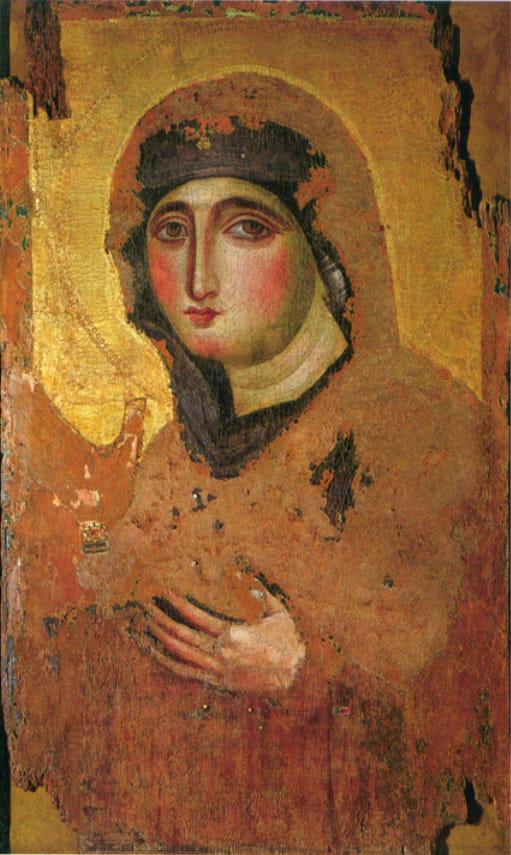
I remember an evening when I was in high school. It must have been my junior or senior year, because I had my driver’s license, and I had driven to the grocery store to pick something up. I was standing in front of that open-front cooler where they keep the sour cream and the shredded cheese and that kind of thing, and I ran into a girl I knew from school. I’ll call her Tonya.
Tonya was a grade younger than me, and she was one of the smartest kids in school. She had a very determined disposition, and everybody knew she was a hard worker, and she was known for making perfect grades. If I remember correctly, she was on the basketball team when we were in junior high, and despite being only about five feet tall and not especially athletic, Tonya carved out a role as a defender, and her matchless hustle carried her through. I remember thinking, as I bumped into Tonya in the grocery store, that I hadn’t seen her for a while—that she hadn’t been around school. As she turned around and we caught each other’s eyes, I saw that she was holding a baby.
The baby was young, and Tonya had a haggard weariness about her that even then I recognized as the look of a new mother. Although I wasn’t always very quick on the uptake about such things, I realized all at once why I hadn’t seen Tonya around school lately: she had gotten pregnant and dropped out to have the baby. We said our smiling hellos, I admired her baby, and we went our separate ways. I never saw Tonya again.
That kind of story is probably familiar to a lot of people. Maybe it’s even your story, or the story of someone you love. It’s one of the great structural inequalities of the human race: that it takes two people to conceive a child, but only women inevitably face the full consequences of unplanned pregnancies. Sure, sometimes men do take on some of the burden, but there usually isn’t anything that says that they have to. It’s not their body, and it’s usually not their reputation that is on the line in the same kind of way, and more often than not the men in those situations find a way to move on with their lives. But Tonya, and other women like her, cannot move on quite so easily.
I thought about Tonya as I read the gospel passage from the lectionary for the fourth Sunday of Advent. The passage is the account of Jesus’ conception and birth as told by Matthew, and it is told from the perspective of a man. It’s the story of a pregnancy, but only the parts that mattered in a man’s experiences. If we reduce the story of this pregnancy to its major plot points, we get a parade of gaps and omissions: a man and a woman were engaged, then the woman got pregnant somehow, then the man decided to slip away quietly, then someone told him that he couldn’t just bail on her that way, then he married her anyway, and then the baby arrived. The list of what’s missing from this story is much longer than the list of what’s included. How did Mary get pregnant? (Let’s assume that from the Holy Spirit was, and remains, an unsatisfying answer). What about Joseph’s righteous nature led him to choose a private disgrace for Mary, rather than a public one, and in what sense did it qualify as righteous? How did Mary feel about that plan for a private disgrace, and did she get a vote? How did Joseph feel about the angel’s explanation and encouragement; did he find it somehow less alarming to imagine a deity impregnating his fiancée, rather than another man? What did he will save his people from their sins mean to Joseph, in the middle of the crisis of an unplanned pregnancy and a divine exhortation to keep the kid in the family? Why is everything about the embodied experience of pregnancy and childbirth omitted from this account? It’s like someone fast-forwarded the movie past all the messy parts, and then hit play again when the dad got to give the kid a name.
I don’t mean to cast aspersions on Jesus’ parentage. I wasn’t there, and I don’t have any special insight into whether the whole from the Holy Spirit bit was true or not. And in a larger sense, it’s irrelevant to the point I’m trying to make, which is that this is the story of a pregnancy from a man’s point of view, and not an especially thoughtful or curious man at that. It does not take much imagination to conjure the panic that Mary must have been feeling, turning up unaccountably pregnant in a patriarchal society that privileged male ownership and control of women. It does not take much curiosity to wonder about the months between a pregnancy beginning to show and the birth, and what that waiting must have been like—especially given all the talk of Holy Spirit parentage. It takes a powerful aversion of the eyes to skip past all the terror of giving birth at a time when both child and maternal mortality were commonplace, and when the slightest complication could be a death sentence. At least Luke gives us the Magnificat, and a glimpse into Mary’s thinking, even if its outlook is unreasonably sunny. At least Mark and John had the courage of their convictions, and skipped past the whole business. Matthew offers the kind of story Tonya’s high school boyfriend might have told his buddies later on: yeah I tried to break up with her, but her dad made me marry her.
Maybe you think I’m being flippant about things, but I am in earnest. Here’s why: this kind of gap in the text is an invitation to creativity. This kind of narrative failure is an enticement to wonder. At best, Matthew’s account of Jesus’ conception and birth is told by a narrator who’s profoundly unconcerned with women’s experiences, and at worst, it’s bad storytelling. So there’s an opportunity there, if we choose to take it, to write and rewrite the story ourselves. There are gaps in this text wide enough to drive feminism through, or queerness, if that’s more your speed.
Where does Mary’s agency fit inside that passive voice in verse 18, she was found to be pregnant? Who found her to be pregnant, and why are we avoiding saying that part out loud? What was that morning like, or did the finding happen more than once? Perhaps first Mary was found to be pregnant by Mary herself, and then she threw up in secret for a week, but she couldn’t tell whether it was because of the baby or the fear. And then maybe Mary was found to be pregnant by her mother, who knew all the signs and suspected it for two days before asking Mary outright, and they both smiled and cried. And then after that, it could be that Mary was found to be pregnant by her father, with her mother standing in between them to keep her dad away, incandescent in his patriarchal woundedness? She was found to be pregnant is such a gutless way to say it, and I guarantee that Mary could have written it better.
How did Joseph’s righteousness look through Mary’s eyes? Matthew makes him into a bit of a heroic figure, chivalrous in his resolve to divorce Mary in a way that wouldn’t bring him any shame, but would probably still bring her plenty. Did she loathe him? Did she desire him? Did Mary want to carry Joseph’s baby, or did she know too much about how the baby got there? What did she think, when she heard about his dream and the way the angel told him, for the child conceived in her is from the Holy Spirit? Did she roll her eyes when she heard that, or grin a sly grin, or avert her eyes to the floor?
Did Mary’s mother and aunts tell her, from the way she was carrying, that the baby would be a boy? Or did she hear it first from Joseph and his angel? Do angels know that it might be a boy when a woman carries low? Or is that a more of a human species of prophecy?
Look, the virgin shall become pregnant doesn’t read that way in the Hebrew, and that’s how all of them probably would have heard it, if they had ever heard anyone read from Isaiah before. They wouldn’t have known about how the Greek translations introduced the idea of virginity into things, reaching right past the notion of a young woman in the Hebrew to suddenly make her sexually spotless. It’s a high bar that the Greek sets. The Greek takes the Hebrew sense of Isaiah and turns it toward the puritanical.
And if Mary ever heard someone quote that verse to her about herself, the verse that Matthew quotes in 1:23, how did she feel about it? Did she remember being a young woman, and forget about being a virgin? Did she point out that the angel’s suggestion of Jesus and Isaiah’s Emmanuel were two very different names?
He took her, it says of Joseph in 1:24, as his wife. That’s a common and customary way of saying that a man married a woman, and yet it’s still jarring, when you slow it down and pay close attention to the words. He took her as his wife. The language of taking feels gratuitous in this story, which is already a story from a man’s point of view, with no suggestion that Mary also took him. Maybe she didn’t take him. There are lots of ways we could tell the story. Maybe it’s a clue, that he had no marital relations with her until she had borne a son, another chivalrous feather in Joseph’s cap. How does the narrator know about the marital relations? Was it Mary that relayed that detail to Matthew as a way to rehabilitate her honor in her old age, or was it Joseph who said it while burnishing his righteousness, or did it just seem to Matthew like the kind of detail that ought to have been true—true enough to put into the story?
I have given up trying to figure out why certain scenes stick in my mind after so many years—what accounts for the perseverance of one moment among countless others. But I think often of that night in the dairy aisle at the grocery store, Tonya standing there smiling in a guarded way that told me that she was already used to people saying hurtful things when they saw her cradling a baby. The interaction has stuck with me for something that happened so long ago, and now that baby is thirty years old, and I don’t know what kind of sense Tonya makes of the whole thing these days, with all her intelligence and determination. Perhaps she thinks back now and chalks it all up to the Holy Spirit.