Enmity and Difference
Reflections on the Lectionary for the Third Sunday of Lent

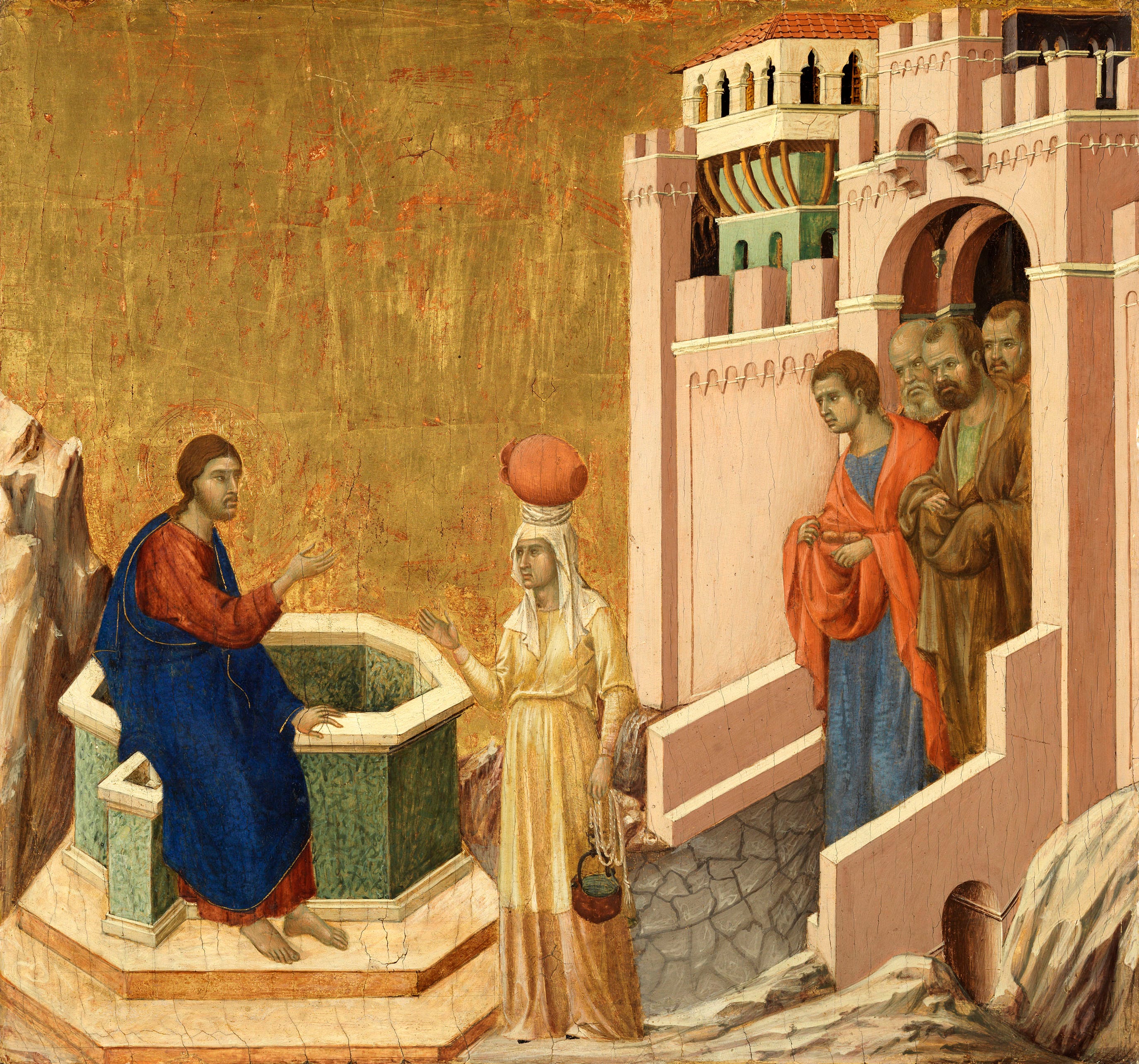
The Gospel of John is beautiful, but it can also be harsh. That gospel sees the world in stark terms, and its pages are filled with allies and opponents, insiders and outsiders, divine and human—dichotomies that structure many of its stories. This oppositional posture creates a distinctive vision of Jesus; while the Synoptic Gospels portray Jesus as the leader of a band of itinerants, the Gospel of John portrays Jesus as a god come down to earth, an otherworldly being sojourning among people, always several steps ahead of everyone else, and not of the same nature as anyone he meets.
John’s tendency to sort the world into this-and-that patterns shows up strongly in the gospel reading in the lectionary for the third Sunday of Lent. This is one of my favorite stories in all of the New Testament: the story of the Samaritan woman at the well. Here as elsewhere, John shows the reader how the world is arranged in patterns of opposition and enmity—how Jesus’ passage through the world is filled with encounters with people to whom and with whom he does not belong, and who do not understand him. We saw it last week in Jesus’ encounter with Nicodemus, and we see it again with the Samaritan woman, who is very much meant to be interpreted alongside Nicodemus as paired examples of Jesus being misunderstood.
The story of the Samaritan woman plays out differently than the story of Nicodemus, even though they are structurally quite parallel. In both stories Jesus encounters someone, but in one story it’s in the middle of the night and in the other it’s at midday, and in one it’s a man and in the other it’s a woman. In both stories Jesus is misunderstood; in both stories the misunderstanding reveals something theologically important. In both stories something is revealed about Jesus’ identity vis a vis other groups—as opposed to other “teachers of Israel” in one story, and as opposed to Samaritans in the other. And in both stories the encounter ends with the departure of the other person, though Nicodemus departs into the unresolved night and the Samaritan woman departs to share the emphatic news of her meeting. The overall effect is that Nicodemus—a Jew, a learned teacher, an insider—is shown to be stuck in misunderstanding, while the Samaritan woman, an outsider, is shown to be receptive to Jesus’ teachings. There’s all kinds of play with categories of insiders and outsiders, understanding and misunderstanding, and belonging and otherness.
I want to focus on the dichotomies—the emphases on otherness—found in the story of the Samaritan woman. These dichotomies pervade the story, even as the story as a whole seems to want to subvert them and overcome them. John almost seems to be trying to pack as many oppositions into the story as possible, just to show how easily Jesus breezes past them. It’s the overcoming of difference that drives the plot, and it’s the surmounting of all the things that ought to make the story impossible that turn the Jesus of this story into a unifying and harmonizing figure.
The first and most obvious opposition is Samaritan vs. Jewish. This is how the whole story itself is framed: with Jesus coming to “a Samaritan city,” meeting “a Samaritan woman,” and being asked “how is it that you, a Jew, ask a drink of me, a woman of Samaria?” The story’s central theological metaphor of living water would have worked just fine with any encounter with any person at any well (or not at a well, too, really). But John fills this text with reminders of ethnic difference, making sure the readers know how foreign and estranged this woman and Jesus ought to have been from each other. “Jews do not share things in common with Samaritans,” the narrator reminds us in 4:9b (in what I think was likely a scribal marginal note that got copied into the text at some point). These were two people—who were representing two nations, as we will see below—who were not supposed to be in any relationship with each other than a hostile one.
Why? That’s a complicated historical question. It all goes back to the 700s BCE, when the Assyrian Empire defeated the northern kingdom of Israel, leaving the southern kingdom of Judah intact. Following their victories over rivals, the Assyrians employed an especially cruel and effective strategy for suppressing rebellion. They took the political and economic leaders of the conquered people somewhere else—they deported them to some other conquered place. And in turn, they brought in deportees from elsewhere—merchants and artisans and administrators and such—to help run the newly conquered territory. In this way, the Assyrians decapitated societies, ensuring that the people most likely to mount a nationalist rebellion were living far, far away. In the case of the northern kingdom of Israel, the Assyrians imported conquered outsiders to help keep the economy and government going, which predictably led to generations of intermarriage and ethnic mixture. A couple of centuries later in the early 500s BCE, the Babylonian Empire conquered the southern kingdom of Judah and did the same thing to them, bringing in outsiders and deporting many people to their capitol city. Upon the return from Babylonian exile a couple of generations later, the exiled Judahites set out to rebuild their society, including rebuilding their temple in Jerusalem, and rebuilding Jerusalem itself. That dynamic—returning exiles from the southern kingdom, a project of restoration in Jerusalem, and an ethnically mixed population in the former northern kingdom—led to some difficult struggles. There is evidence in Ezra and Nehemiah that the so-called “people of the land” (who were likely the ethnically mixed former northerners, the precursors of the Samaritans) and the returning Judahites clashed over ownership of the land, the symbolism of rebuilding the temple, and identity itself—over who belonged with whom, and where.
That’s why, another five or six centuries onward, Jesus and this Samaritan woman spent so much time talking about why they shouldn’t be talking to each other, and talking about their shared history and inheritance. They were both descendants of Jacob, after all, and they both understood themselves to worship the God of Israel, but they had very different understandings of where and how they should do it. They “did not share things in common” with each other, because of centuries and generations of enmity and difference. The Gospel of John places all that enmity and difference at the forefront of the story, never letting the readers forget how much stood between them. (And it’s remarkable that the only unambiguously good thing that the famously anti-Jewish Gospel of John ever says about Jews comes in this story, in 4:22, where Jesus says that “salvation comes from the Jews.” John is always anti-Jewish, unless he wants to draw attention to the power and status of Jesus by virtue of his Jewishness).
But ethnic identity wasn’t all that kept them apart. Gender also plays a crucial role in this story, and it forms another axis along which Jesus and the Samaritan woman are placed at opposing ends. John neatly tucks that difference into the question the Samaritan woman asks—the one we have already seen. “How is it that you, a Jew, ask a drink of me, a woman of Samaria?” She might have said “a Samaritan,” but she names her own gender as a way of highlighting that it was not only ethnicity but also gender that distanced them from each other.
Indeed, this whole story is rife with performances of gender—and performances of what we might today call misogyny. In verse 7, Jesus rolls into the town, posts up at the well, and demands a drink from the first woman who comes along. Why couldn’t Jesus get his own drink? What made him feel entitled to make demands of a stranger? Was he used to being served in this kind of way? (The disciples’ reaction in verse 27, “they were astonished that he was speaking with a woman,” makes it seem like they did not see him interacting with women very often). The woman is taken aback; her question in verse 9 makes it clear that she had not expected any interaction from Jesus, much less a demand for service. And then later, beginning in verse 16, gender once again bursts onto the scene. “Go, call your husband, and come back,” Jesus tells her, and this new demand sets off a punchy and tense back-and-forth about the woman’s status. The woman responds that she has no husband. (Take a moment to perform the line “I have no husband” a few times, emphasizing a different word each time, and imagining which intonation the woman might have used, because it makes a tremendous difference in the meaning of her response). Jesus then shows that he knows more about this woman than he has been letting on: “You are right in saying, ‘I have no husband,’ for you have had five husbands, and the one you have now is not your husband.”
There are many fascinating possibilities for making sense of this woman’s predicament. Most likely, in my opinion, she had been a participant in a levirate marriage, a practice in which women who did not conceive a son before the death of a husband entered into a purpose-specific “marriage” with a close male relative of her husband, in order to produce an heir for the dead man. (This is part of the plot of the story of Naomi and Ruth and Boaz, and also Tamar and Judah, and fascinatingly of the story of Onan, the classic proof-text against masturbation). I think it probable that she was infertile, or else that her dead husband was infertile along with his family, and she was passed from relative to relative until everyone gave up. Whatever the case was, this woman was not—as many modern interpreters seem to conclude—a promiscuous woman who chose all of her marriages. That simply was not how marriage worked at the time. “The one you have now is not your husband,” Jesus remarks, suggesting that she was in a relationship with someone besides the final male relative. I hope that in this last relationship, she was able to find happiness.
All of that, though, emphasizes the distance between men and women. John’s telling of the encounter depends on gender differences and plays them up. And in one last twist of the gendered knife, in verses 39-42, the people of the city believed in Jesus because of the woman’s testimony, until they had a chance to meet Jesus himself. After that, they made a point of going to the woman to tell her how little her witness now meant: “it is no longer because of what you said that we believe, for we have heard for ourselves,” they told her. The Gospel of John really wants us to remember that the Samaritan woman was only a woman. Jesus, by contrast, is “a man who told me everything I have ever done” (4:29). His man-ness is central to John’s portrayal of him.
Beyond ethnicity and gender, the Gospel of John offers readers other signals that Jesus and this woman should be thought of in opposition to each other. My favorite example comes in a subtle but important transition that takes place in verses 20-22. Up until that point, the “you” of Jesus’ conversation with the Samaritan woman had been singular. They were talking directly to each other. In 20 (“…but you say that the place where people must worship is in Jerusalem”), 21 (“…the hour is coming when you will worship…”), and 22 (“You worship what you do not know…”), the “you” becomes plural. This is invisible in English, which does not really have a distinctive second person plural pronoun. (Shoutout to y’all, one of the most needlessly denigrated words in English). But in Greek, it is obvious that Jesus’ conversation with the Samaritan woman passes from a one-on-one exchange into a discussion between two ethnic groups, two religious groups, or two nations. Suddenly, Jesus and the woman are speaking not only for themselves, but on behalf of much larger collections of people. It’s a reminder that this whole exchange is grounded in that deep history of imperial violence, and in the enmity and difference that was imposed on Judahites and Samaritans over 700 years earlier. The substance of their conversation in those same verses—the question of whether proper worship should be carried out “on this mountain” (Mount Gerizim, where Samaritans worshipped) or in Jerusalem also dates back to that same period of Assyrian destruction. Even centuries later, Jesus and the Samaritan woman stand at opposite sides of a divide. And the Gospel of John does not want us to forget it.
The dichotomies of belonging and identity frame this story in John, as they do so many of that gospel’s stories. The upshot of this story, I think, is that Jesus is powerful enough and compelling enough to transcend those kinds of ancient differences—even as his words in the story reinforce some of the differences and reiterate the supremacy of his own people over the woman’s people (see 4:22 and 4:26). John parades all the oppositions and dichotomies—he tells the story in terms of enmity and difference—precisely so that he can demonstrate Jesus’ power to overcome them. In our own age of deep and sharp grievances—in our own time of dichotomies and enmity—the story of the Samaritan woman at the well offers a glimpse of what it looks like to resolve those kinds of separations, or at least to talk about whether they still hold any power. This isn’t some parable about leveling inequalities, or forgetting about old grudges. But it is a story about how new circumstances can lead us to understand that our inherited prejudices might not be worth defending anymore.
I'm trying to put a positive spin on the "dialogue" aspect of it to preach it on Sunday, but I have always bristled at how JC talks to her!