Birthrights
Reflections on the Lectionary for July 12th

Sometimes it happens that the headlines of the world’s news and the cycles of the church calendar line up. I remember, for example, how President Trump made his shithole countries comments just on the heels of Advent during his first term, when Christians were already thinking about migration and refugees and finding the divine in poor conditions, because they had heard the story of Jesus’ birth. And I remember how many Christians rightly reacted in condemnation of the President’s remarks. Or I remember how, in the aftermath of 9/11, the lectionary included a Psalm of vengeance and fury and nearly genocidal violence that helped give voice to people’s anguish and also call it into question. The lectionary offered people a mirror for their wrath, and a pathway by which they could walk away from it. The resonances between the church year and the cycles of lectionary readings and the events of the world can be powerful, and even spooky.
This week is a great example of that. A week ago, the United States Supreme Court issued a ruling on so-called birthright citizenship, and what do you know: birthrights are right there in the lectionary for this Sunday. The story of Jacob and Esau and their birthright is a story of deceit, unfairness, and favoritism, and those are the same themes that have characterized the discourse about birthright citizenship in the United States. Sometimes it feels serendipitous or providential, the way our traditions give us ways of understanding the world we live in.
The question of American birthright citizenship is rooted deep in the brokenness of this country. Birthright citizenship is conferred by the 14th Amendment, which was ratified in 1868. A decade earlier, in 1857, the infamous Dred Scott case had barred enslaved people from availing themselves in court proceedings, on the grounds that they were not citizens. Because Black people had been brought here to be enslaved, the Court held in what’s widely regarded as the worst decision in its history, they could never be full persons. In the aftermath of the Civil War, the 14th Amendment righted that egregious wrong, and made it clear that all persons born or naturalized in the United States, and subject to the jurisdiction thereof, are citizens of the United States and of the State wherein they reside. Some (increasingly many) conservative politicians pretend not to understand that language, and play games with the clause subject to the jurisdiction thereof, but over a century of jurisprudence and a knowledge of the context of 1868 and a simple grasp of the English language makes it clear what the 14th Amendment means: if you’re born here, unless it happens under some very specific circumstances, citizenship is your birthright.
But we live in a time of the theft and pilfering of rights of all kinds, and few rights offend White nationalists as much as this one. Stephen Miller, the White House advisor, said in an interview that 14th Amendment was offering citizenship to babies from countries who never would have invented the wheel, implying (or really just stating outright) that White nations are intellectually superior to other nations. Miller also called birthright citizenship a national self-obliteration. Vice-President JD Vance called it the dumbest immigration policy in the world.
These figures and others on the White-nationalist right prefer a different version of birthright. A new idea has bubbled up on the right in the last few years: heritage citizenship. This is the notion that some people have more legitimate, deeper ties to America than others, and that people who can trace their ancestry to conflicts like the Revolutionary War and the Civil War are somehow closer to the heart and truth of America than everyone else. This runs directly counter to the more common notion of America as a nation of ideas and ideals—a collective defined by shared principles and commitments. Instead, JD Vance and others who espouse heritage citizenship would prefer to rank us all according to the Americanness of our ancestry. It’s not hard to see where that line of thought is going. It’s leading right back to decisions like Dred Scott, which held that Scott could not be a citizen because his ancestors had been brought here in chains, as slaves, and that the founders never intended someone like him to be a citizen. Citizenship, in that way of thinking, is a birthright only for certain kinds of people. (It is not accidental that the United States now has accepted only White refugees for six consecutive months, as of June 2026).
On the right, many of the arguments against birthright citizenship (or citizenship by naturalization for that matter, for anyone who isn’t White, or even citizenship by inheritance for people like Dred Scott) hinge on the idea of theft. They think it is illegitimate for a person who isn’t like them to share in their belonging. For White nationalists, belonging is tribal and ethnic, and if anyone else has the same belonging as them, then they must have stolen it. They can’t conceive of forms of togetherness that rely on ideas rather ethnicity.
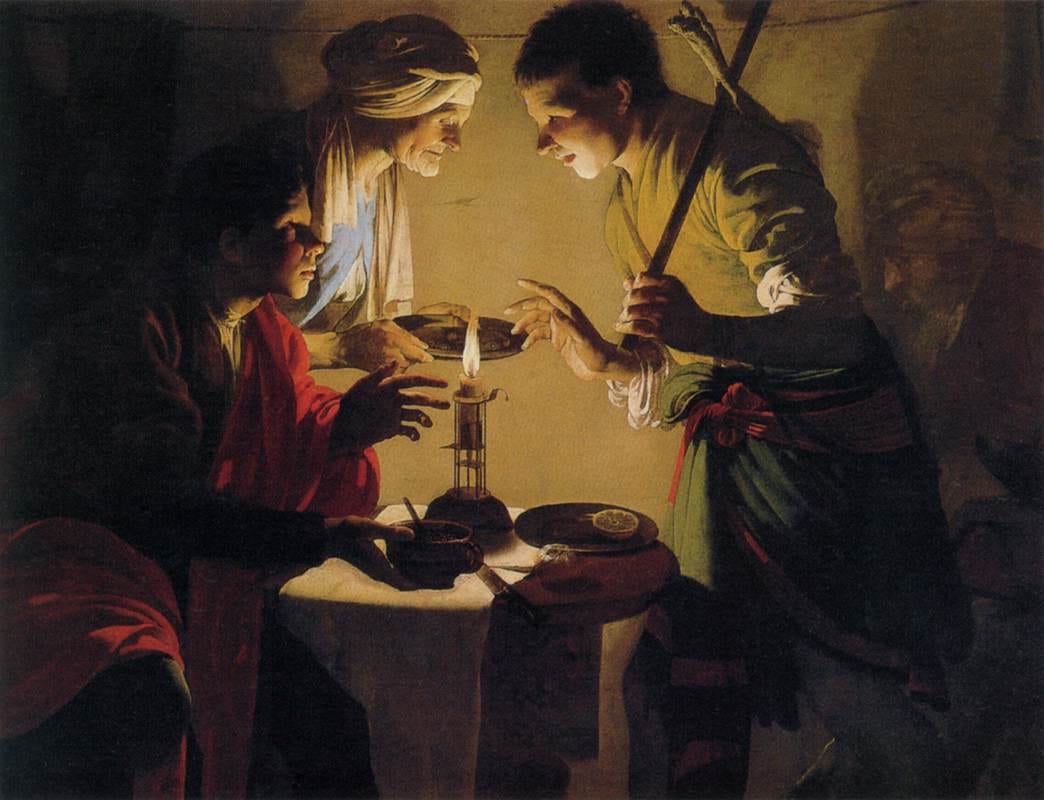
This story from Genesis is weird. Like so many stories from Genesis, this one is dreamlike and mythological, taking place in the same register as folk tales, with the same vagueness of meaning. Two brothers, twins, born in rivalry. Two parents, each favoring a child. One birthright, to be squabbled over. The low stakes symbolism of some stew, the naked selfishness of ambition, a resonance beyond the brothers and into the realm of nations and peoples.
Likely, this story was written as an etiology of nations—as a way to explain or argue for one nation’s precedence over another. Like the lectionary’s story of several weeks ago, in which Abraham and Sarah drove Hagar and Ishmael into the wilderness, this story is an origin story for the national prejudices that dominated the world of the authors of the Hebrew Bible. If you loathe the Edomites, what better way to put them in their place than to make their ancestor the vanquished twin brother of your own nation’s avatar, Jacob? Why not put them in a story and have your guy win, so that you can claim perpetual bragging rights? Stories like this one existed to make the past justify the present.
It’s a form of using the past to justify the present, to claim that you’re only a real American—a heritage American—if your ancestors fought in the Revolutionary War. My ancestors fought in that war; I pass JD Vance’s test. But it’s hard for me to see any relationship between what my great-great-great-great-great grandparents were and did and what I am and do today. Scientifically, going that far back I might not share of my Revolutionary War ancestors’ DNA at all, aside from a stray strand here and there, and I am nearly completely ignorant of the ideas and commitments that led them to enlist in that war, aside from what I have been able to gather from context clues and the cursive minutes of some 18th-century Quaker meetings. Certainly my heritage DNA does not lead me to understand citizenship and belonging the same way as Stephen Miller and JD Vance and the four Supreme Court justices who were willing to read the Fourteenth Amendment dishonestly, against its plain meaning.
What’s the role of dishonesty in the story of Jacob and Esau? In preaching and in biblical scholarship, Jacob is often described as a trickster figure, as a dishonest-but-noble character who does the wrong thing for the right reason, or who is the protagonist despite cutting some ethical corners. That’s an interesting framing. Jacob famously tricks his father Isaac into giving him a blessing, instead of his brother Esau. He tricks his father-in-law Laban, going behind his back to game Laban’s livestock herds for his own gain. (Laban, though, was a trickster himself, and might have had it coming). This story—the story of the birthright—is often lumped in with those two stories of trickery, but it’s not, really, the same kind of story. Here Jacob doesn’t trick Esau so much as he bullies him—he takes advantage of his brother in a moment of need. Esau, in verses 29-32, is starving, and about to die, and so he sells his birthright to his brother in exchange for some stew. Jacob gets the birthright in a fair and open trade, but a good brother, in that moment, might have offered his twin something to eat free of charge. A good human, for that matter, would offer food to a starving person without demanding anything in return. But Jacob, knowing that he had the upper hand, pressed his advantage and he disinherited his closest kin.
The story from Genesis is about selling a birthright—or about stealing it or giving it away, depending on how you read the story. Meanwhile in the United States our discussion is slightly different. Certainly, people on the right think that others are trying to steal a birthright—that citizenship is being illegitimately claimed through birth tourism or unchecked illegal immigration or some other means. But really, the position of the American right boils down to something simpler: the idea that some people are owed things by virtue of existing, while others are not. The notion of heritage citizenship argues that someone like me ought to receive everything at birth, all the privileges and power of citizenship, because of the accident of my ancestry and phenotype. Meanwhile someone whose ancestors came from one of those countries who never would have invented the wheel, as Stephen Miller put it, are owed nothing, because of their ancestry. (History note: the wheel was probably invented in Mesopotamia or the Indus River Valley, by brown people, certainly not in the United States of America, which did not exist until about 6,500 years after first evidence of the wheel’s use, and absolutely not by American White people). The 14th Amendment was proposed and ratified in the first place because America had decided—through bloody, grinding conflict and the truly wretched experiences of slavery—that it no longer wanted to divvy up privilege among persons as an accident of birth.
That’s where America’s story and this story from Genesis converge again: in the question of what happens when birthrights privilege a few over everyone else. After all, this story of Jacob and Esau wouldn’t have been much of a story at all, if it had happened in a society where everyone born, regardless of birth order, received the same rights and privileges. The plot of this tale depends on inequality. In the normal order of things, Esau would have received a large inheritance, and Jacob would have had to make his way on his own. Jacob flipped that equation by stealing the birthright, but the system was set up unfairly from the beginning, with privilege flowing to one person and hardship flowing to another.
America is far from perfect. It has never been a place or a society where everyone begins on equal footing and everyone has a fair shake. But there have been moments in our history where the United States has inched closer to that ideal, and we have seen glimpses of the nation we might become. The Declaration, with its promises of equality. The Bill of Rights, with its assurances of dignity. The 14th Amendment, with its promise of citizenship to anyone born on here. Forces on the right now seek to undo that progress, and to return this country to a system of privilege for the few and subjugation for the many, a system of insiders and outsiders and haves and have-nots.
The story of Jacob and Esau can’t take the place of jurisprudence, or policy discussions, or well-reasoned discussion of the very good reasons for something like the 14th Amendment. Genesis isn’t the Constitution. But it is a cautionary tale; Genesis is a warning, in the way that stories like these often are. If we build a system where only some receive a birthright—if we build a world where a few people get everything and everyone else gets nothing—unfairness multiplies unfairness. Dispossession begets dispossession. Exclusion breeds exclusion. The enmity and hatred that some people receive at their births will come back to everyone else in the form of turmoil and conflict. That’s a lesson that the United States learned well during the Civil War, and we passed the 14th Amendment so that we would never again dole out dignity to some and not to others. But now some have forgotten that lesson, and some people once again want to hoard everything for themselves, to deny it to their siblings, in the name of heritage. You can ask Isaac and Rebekah how that turns out; you can ask Esau what all his privilege got for him, whether all his birthright heritage ever kept his belly full.
"Stories like this one existed to make the past justify the present."
This is why it is so important to pay attention to - and push back against - the current regime's attempts to "white wash" our national story.
Lovely, Eric. A fine echo of Omar El Akkad's words, too: "It is a hallmark of failing societies, I've learned, this requirement that one always be in possession of a valid reason to exist."